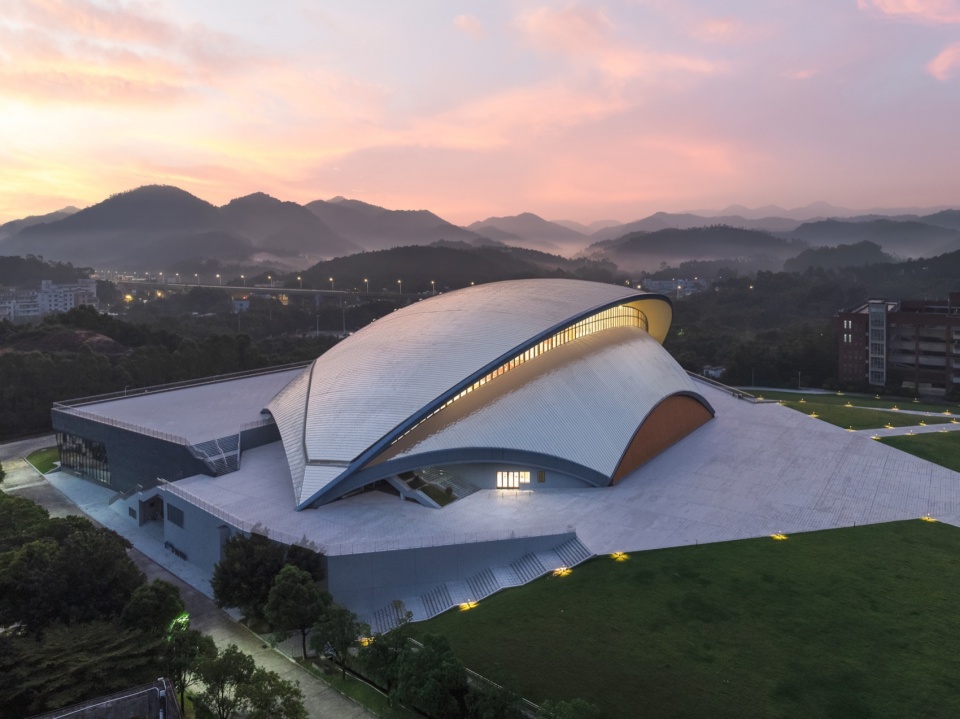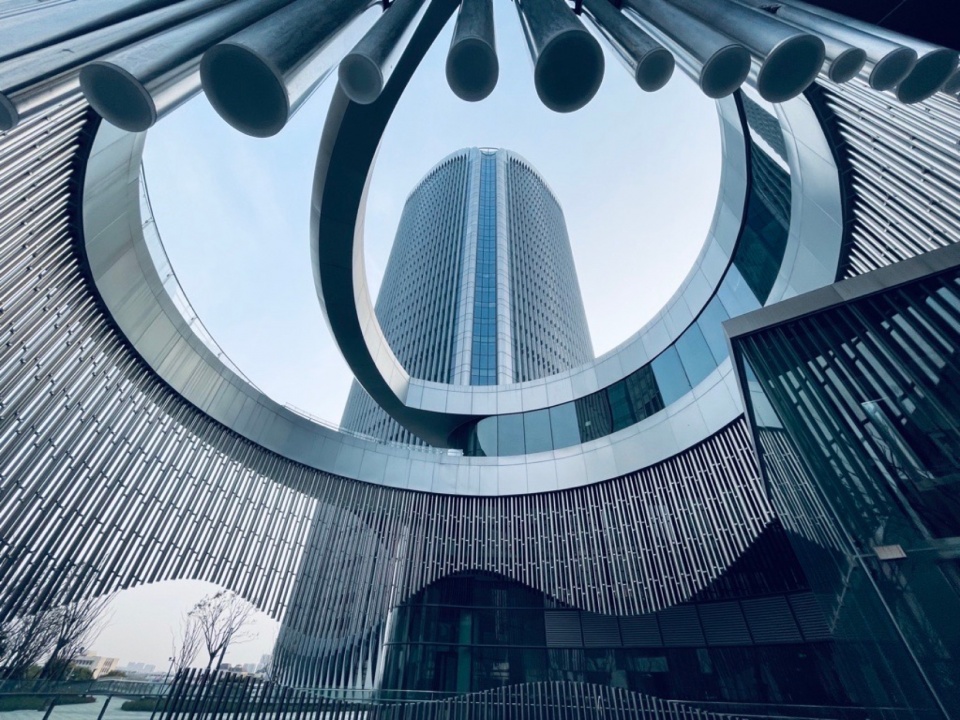



城市背景:秦岭巴山间的“西北江南”
Urban Background: The “Jiangnan of Northwest China” Between the Qinling and Bashan Mountains
汉中,这座因汉水横贯全境而得名的陕西地级市,是国务院钦定的中国历史文化名城。它被巍峨秦岭与苍茫巴山相拥,在群山环抱中托举出开阔的盆地地貌;长江两大支流——汉江与嘉陵江在此蜿蜒穿城,既滋养出沃野千里的富庶之地,也勾勒出兼具北方雄浑与江南灵秀的景致。虽地处中国西部,汉中却有着温润的气候与丰饶的物产,风光丝毫不逊江南水乡。千年历史的沉淀,叠加与川蜀文化的深度交融,让这里的生活节奏褪去了西北的爽朗急促,多了几分川蜀特有的从容闲适,形成了独属于这片土地的“慢生活”氛围。
Hanzhong, a prefecture-level city in Shaanxi Province named for the Han River that runs through its entire territory, is a national historical and cultural city. Surrounded by the towering Qinling Mountains and the vast Bashan Mountains, it embraces an open basin landscape amid the mountains. Two major tributaries of the Yangtze River—the Han River and the Jialing River—meander through the city here, not only nurturing a vast, fertile land of abundance but also creating a scenery that combines the grandeur of northern China with the elegance of Jiangnan.Though located in western China, Hanzhong boasts a mild climate and rich natural resources. The accumulation of a thousand years of history, combined with its in-depth integration with Sichuan-Chongqing culture, has softened the straightforward and brisk pace of life typical of northwest China, infusing it with the unique ease and leisure characteristic of the Sichuan-Chongqing region. This has formed a “slow life” atmosphere that is uniquely rooted in this land.
▼城市鸟瞰,aerial view of city © 是然建筑摄影
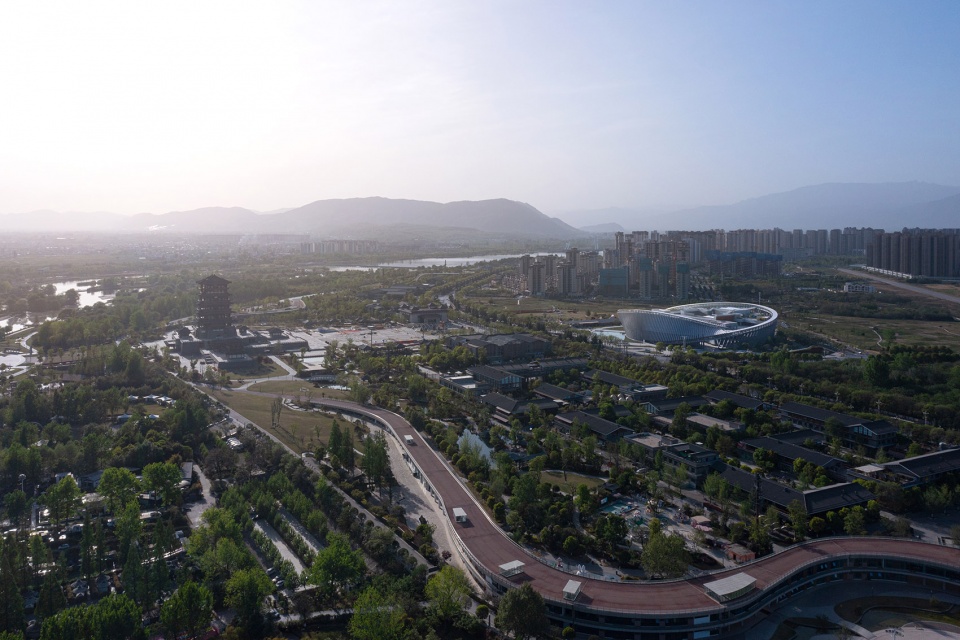
▼西北侧鸟瞰,aerial view from north west side © 是然建筑摄影
天汉大剧院的选址,恰是这片土地的“点睛之笔”——位于汉中老城区以南5公里处,紧邻滨江文化公园,距汉江仅300米。站在此地,近可赏滨江湿地的葱茏绿意,远能望秦岭山脉的连绵轮廓。作为衔接汉江与老城的关键节点,这片用地周边暂未大规模开发,唯有滨江路以南,已建成的汉中文化广场与传统风格高层建筑“天汉楼”静静矗立,为新项目埋下了文化呼应的伏笔。
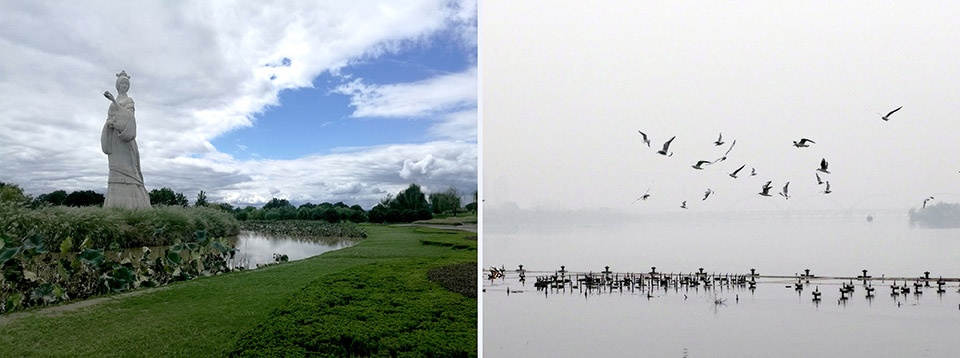
▼汉江沿岸景观及生态环境,Landscape and Ecological Environment Along the Han River © BIAD
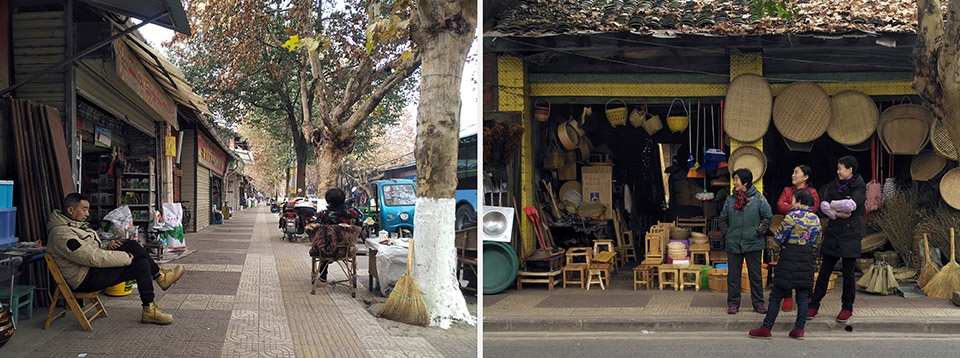
▼汉中老城的市井生活,The Everyday Life of Old Town Hanzhong © BIAD
▼项目区位,Site location © BIAD
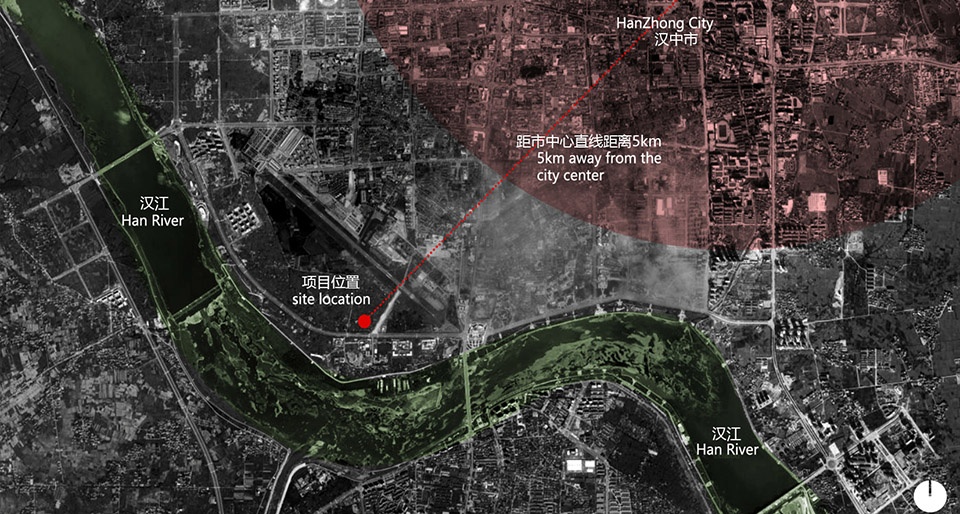
The site selection of Tianhan Grand Theater is truly the “finishing touch” for this land—it is located 5 kilometers south of Hanzhong’s old town, adjacent to Binjiang Cultural Park, and only 300 meters away from the Han River. Standing here, one can enjoy the lush greenery of the Binjiang Wetland up close and gaze at the continuous outline of the Qinling Mountains in the distance. As a key node connecting the Han River and the old town, the surrounding area of this land has not yet undergone large-scale development; only south of Binjiang Road, the completed Hanzhong Cultural Square and Tianhan Tower—a high-rise building with traditional style—stand quietly, laying the groundwork for cultural resonance with the new project.
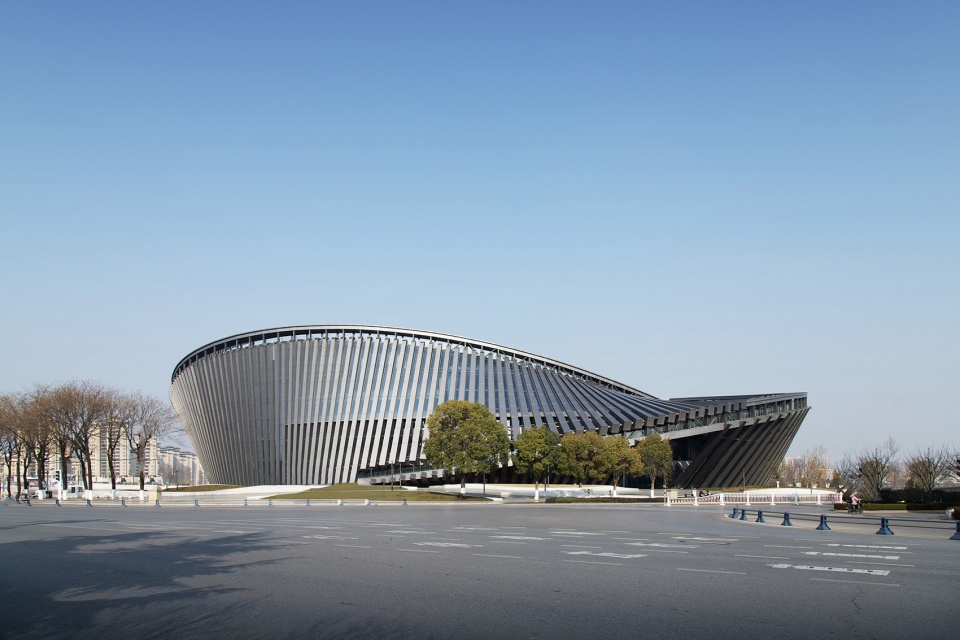
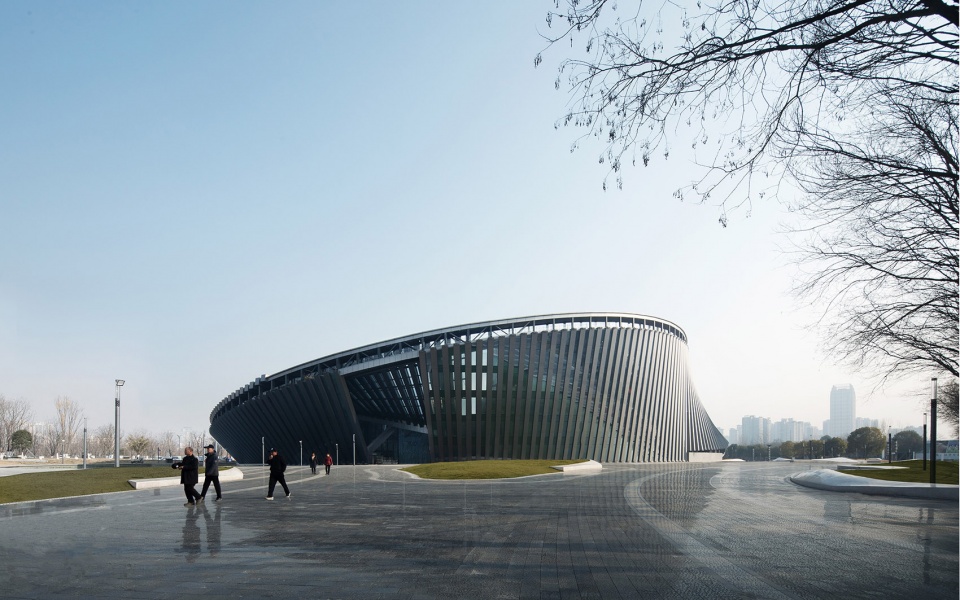
▼东南街角人视,Southeast Street Corner People’s View © 是然建筑摄影
设计缘起:“无中生有”的城市文化锚点
Design Origin: An Urban Cultural Anchor “Created from Nothing”
天汉大剧院项目,始于2013年发起的全国建筑设计方案征集。项目最初的核心功能为大剧院、多功能小剧场与电影院线,而待设计的场地,是城市与汉江交接处一块看似“无拘无束”的空地——没有复杂的既有建筑限制,却也缺少明确的设计依托。如何让建筑在这片空地上“扎根”,赋予其存在的意义,成为破题的关键。
▼概念规划分析,Conceptual Planning Analysis © BIAD
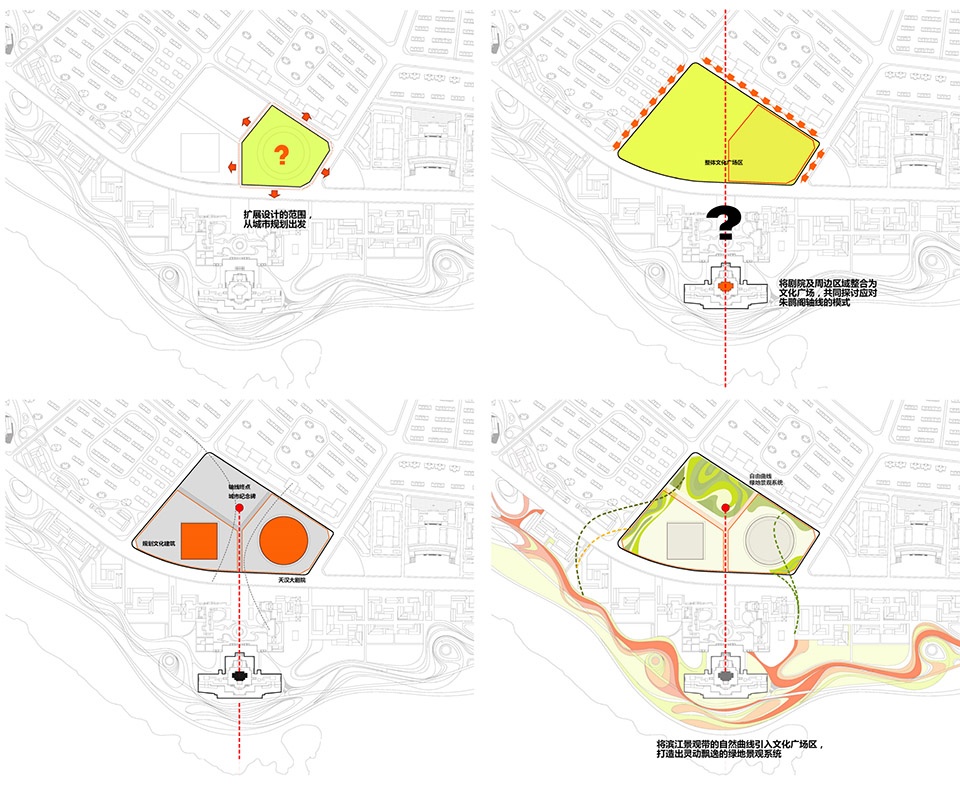
The Tianhan Grand Theater project originated from a national architectural design proposal competition launched in 2013. Initially, the core functions of the project included a grand theater, a multi-functional small theater, and a cinema complex. The site to be designed was an seemingly “unrestricted” open space at the junction of the city and the Han River—free from constraints of complex existing buildings, yet lacking a clear foundation for design.
▼天汉大剧院与天汉楼及汉江对望,Tianhan Grand Theatre faces Tianhan Tower and the Han River © 是然建筑摄影
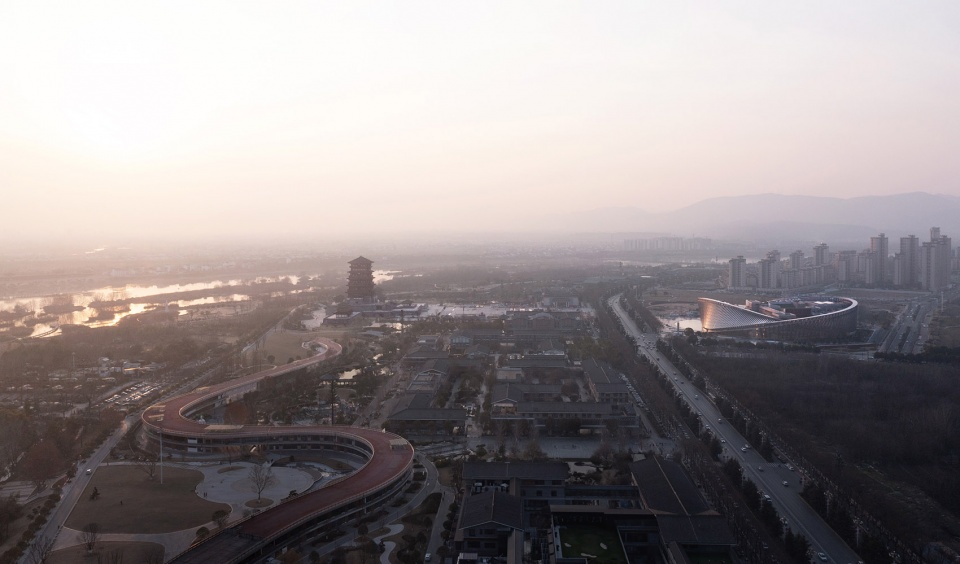
设计团队抓住建筑与自然、人文环境的核心关联:以场地南侧已有的标志性建筑“天汉楼”为空间锚点,顺势拉出一条贯穿南北的城市轴线,将大剧院置于轴线东侧;又因场地坐拥开阔景观,且地处街角节点,遂选定完整的圆形作为建筑形态——如同在新的城市棋盘上落下第一颗棋子,既独立醒目,又与“天汉楼”形成遥相呼应的时空对话。与此同时,设计团队还在轴线西侧规划了另一座文化建筑,轴线北端以标志塔收束,再通过下穿式人行动线,将南侧的文化广场、滨江湿地公园与新建筑群串联起来。这套“以点串线、以线构面”的规划思路,赢得了评审专家的一致认可,也让项目设计权最终落定。
The design team focused on the core connections between the building, nature, and the humanistic environment: taking the existing landmark “Tianhan Tower” as a spatial anchor, they extended a north-south urban axis, placing the grand theater on the east side of this axis. Additionally, given the site’s wide-open views and its location at a street corner node, a complete circular shape was chosen as the building’s form, it stands independently and conspicuously while forming a distant temporal and spatial dialogue with the “Tianhan Tower”. At the same time,we also planned another cultural building on the west side of the axis, with a landmark tower closing off the northern end of the axis. Furthermore, through an underground pedestrian route, the cultural square and riverside wetland park on the southern side were connected with the new building complex. This planning concept of “connecting points into lines and lines into a plane” won the unanimous approval of the review experts, and ultimately secured the project’s design rights.
▼天汉大剧院与天汉楼,Tianhan Grand Theatre and Tianhan Tower © 是然建筑摄影
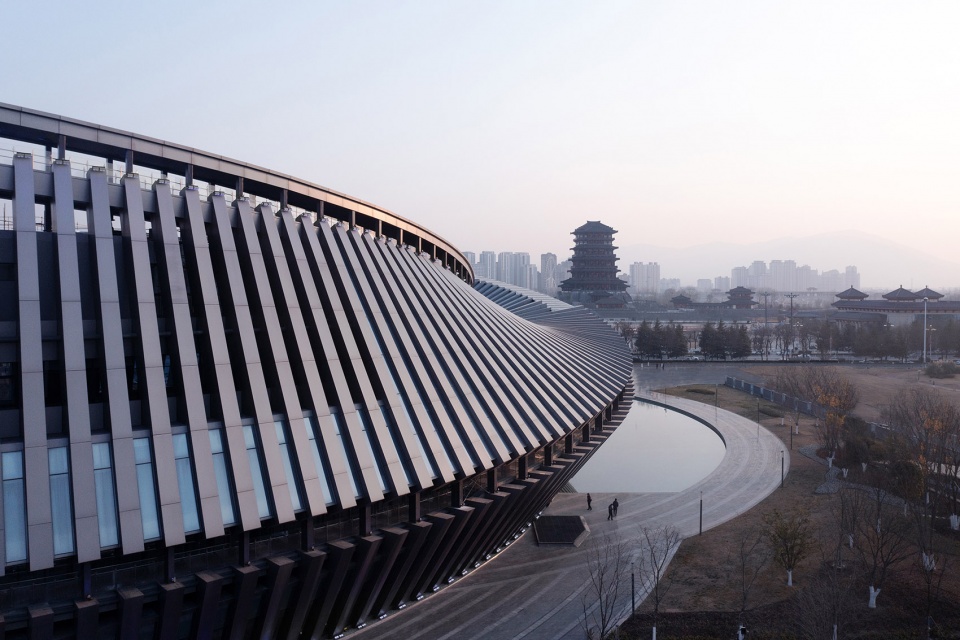
功能流变:从“专业剧院”到“全民文化综合体”
Functional Evolution:From “Professional Theater” to “Cultural Complex for All”
方案确定后,项目因资金问题暂时搁置。直到2017年重启,功能需求发生巨大转变:从原本聚焦演艺的“专业剧院”,扩充为集大剧院、多功能小剧场、工人文化宫、老年活动中心、青少年活动中心于一体的“全民文化综合体”。 新需求带来了新挑战:外观形态与建筑体量已确定,如何在有限空间内妥善排布多元功能?如何保证高密度使用场景下的空间舒适性?如何让功能与造型自然适配,同时控制建造成本?这些难题,反而成了设计团队的创作契机——通过对功能逻辑的重构,让建筑从“单一演艺容器”,变成服务全年龄段市民的“文化生活客厅”。
After the design scheme was finalized, the project was temporarily put on hold due to funding issues. It was not until its restart in 2017 that the functional requirements underwent a significant transformation: from a “professional theater” originally focused on performing arts, it was expanded into a “cultural complex for all” that integrates a grand theater, a multi-functional small theater, a workers’ cultural palace, a senior activity center, and a youth activity center. The new requirements brought new challenges: with the external form and building volume already determined, how to properly arrange diverse functions within the limited space? How to ensure spatial comfort under high-density usage scenarios? How to naturally adapt functions to the building’s shape while controlling construction costs? Instead of being obstacles, these difficulties became a creative opportunity for the design team—through the reconstruction of functional logic, the building was transformed from a “single performing arts container” into a “cultural living room” serving citizens of all age groups.
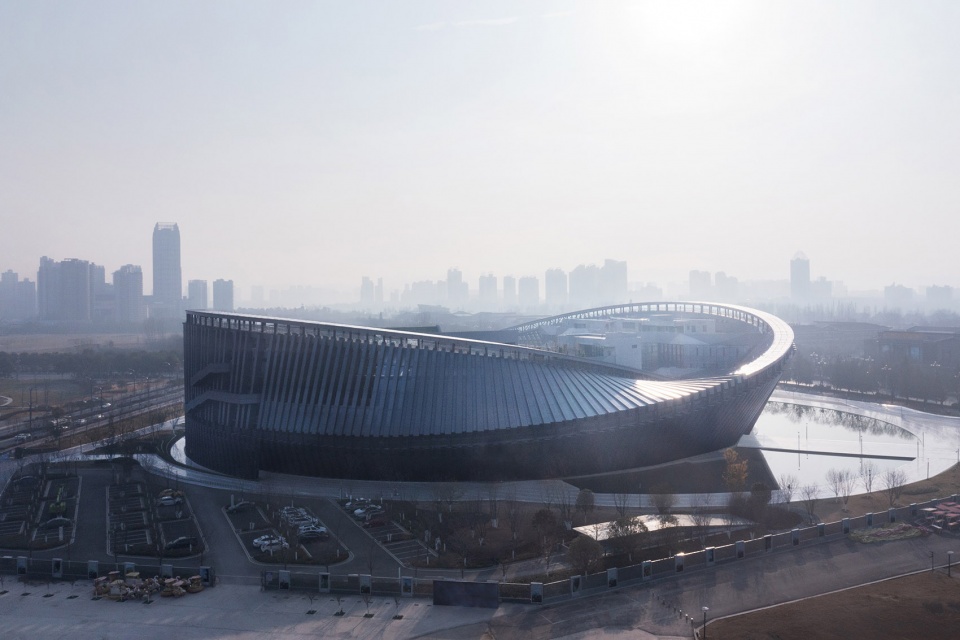
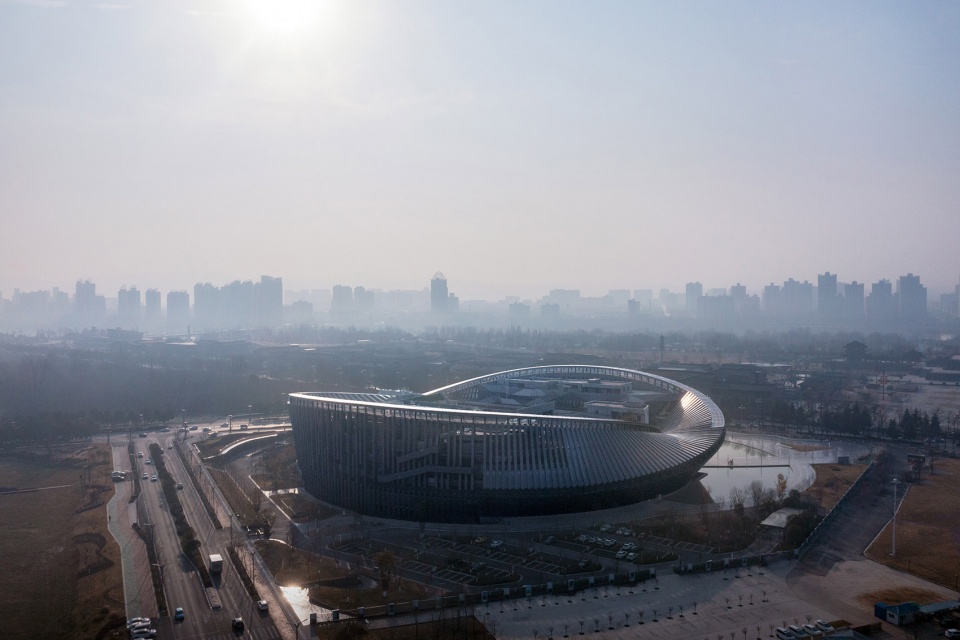
▼天汉大剧院西北侧鸟瞰,Aerial View of the Northwest Side of Tianhan Grand Theatre © 是然建筑摄影
▼天汉大剧院甬道西侧入口,West Entrance of the Tianhan Grand Theatre Concourse © 是然建筑摄影
“行圆思方”:莫比乌斯环里的形态与功能共生
“Acting with Flexibility, Thinking with Integrity”:Symbiosis of Form and Function in the Möbius Strip
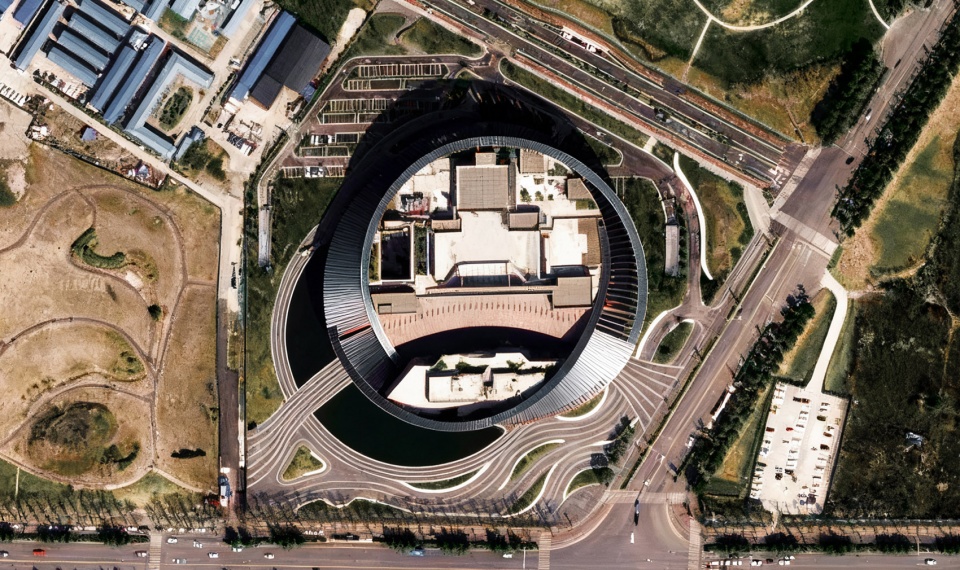
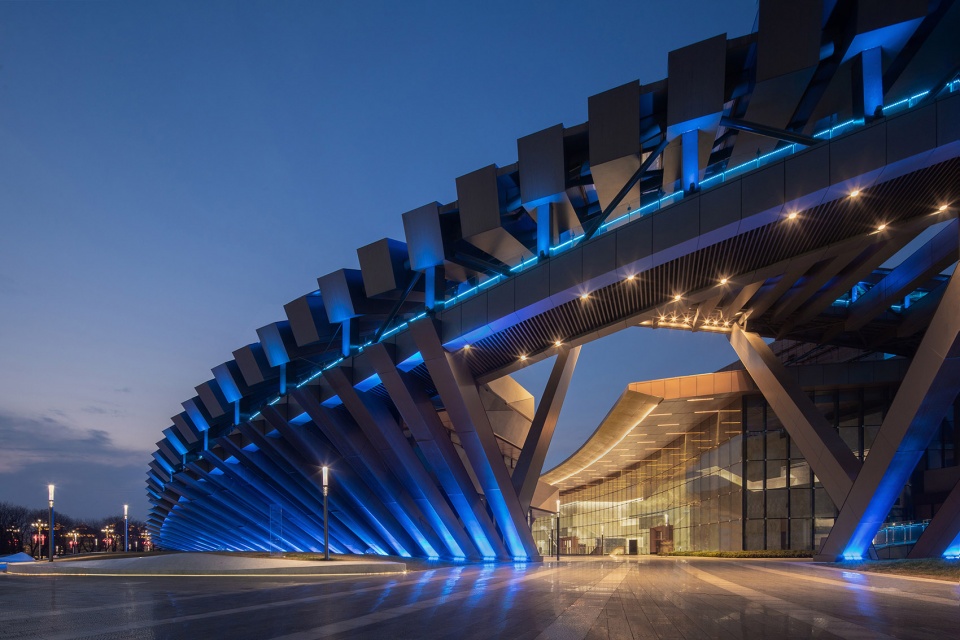
设计团队为建筑定下“外圆内方”的核心基调:外观取圆融之态,既呼应汉江的蜿蜒曲线与周边开阔的自然景观,也让建筑成为一眼可辨的城市标识;内部用方正之序,梳理多元功能的混乱感。这一形态,恰好与传统文化中“行圆思方”的处世哲学不谋而合。发掘“圆”的精神内涵,经过反复推敲,最终选定“莫比乌斯环”作为建筑外皮——既象征“星汉灿烂、循环不息”的意境,又暗合汉中“汉水环流”的地理特征。
▼莫比乌斯环表皮由面到体的演变,The Evolution of the Mobius Strip Epidermis from Surface to Volume © BIAD
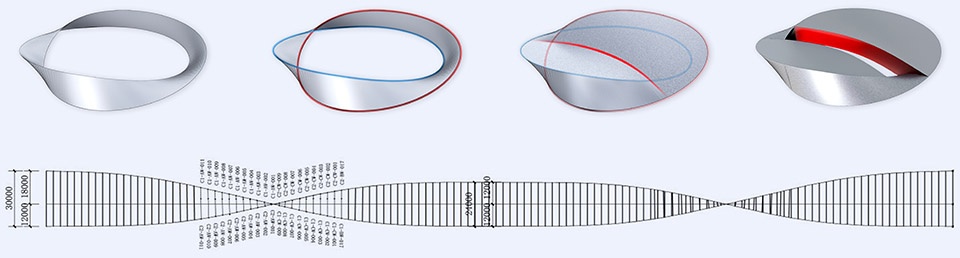
We set the core tone of “round exterior and square interior” for the building: The exterior adopts a rounded form, which not only echoes the winding curves of the Han River and the open natural landscape around it but also makes the building an instantly recognizable urban landmark. The interior follows a neat, square order to organize the complexity of diverse functions and eliminate a sense of disorder. This form coincides perfectly with the life philosophy of “acting with flexibility (yuan) and thinking with integrity (fang)” in traditional Chinese culture. After exploring the spiritual connotation of “roundness” and repeated deliberation, we finally chose the “Möbius strip” as the building’s outer skin—it not only symbolizes the artistic conception of “brilliant stars and endless circulation” but also implicitly reflects Hanzhong’s geographical feature of “the Han River’s circular flow”.
▼建成效果,Completed effect © 是然建筑摄影
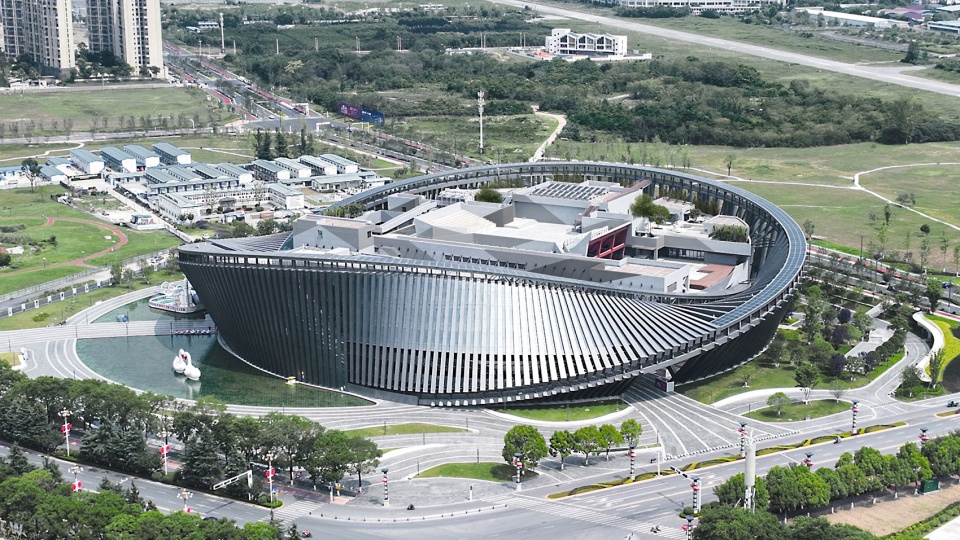
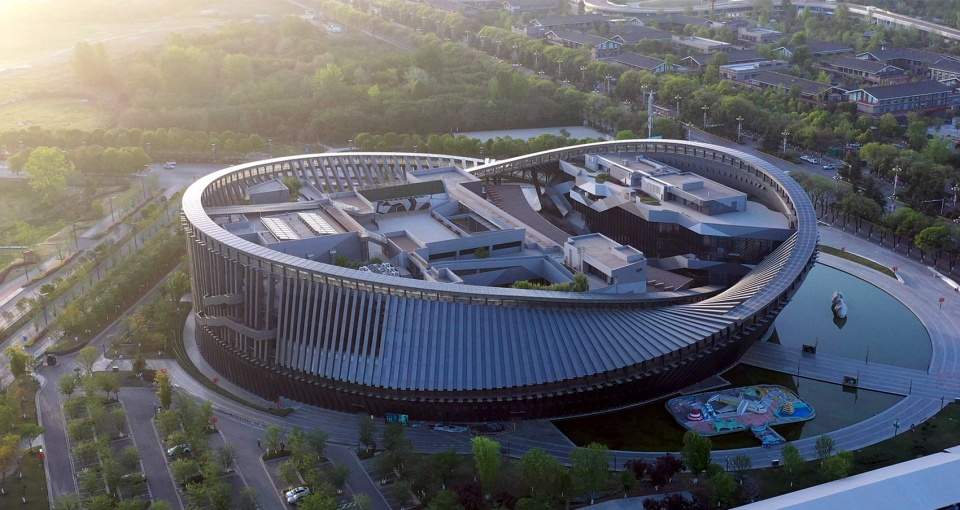
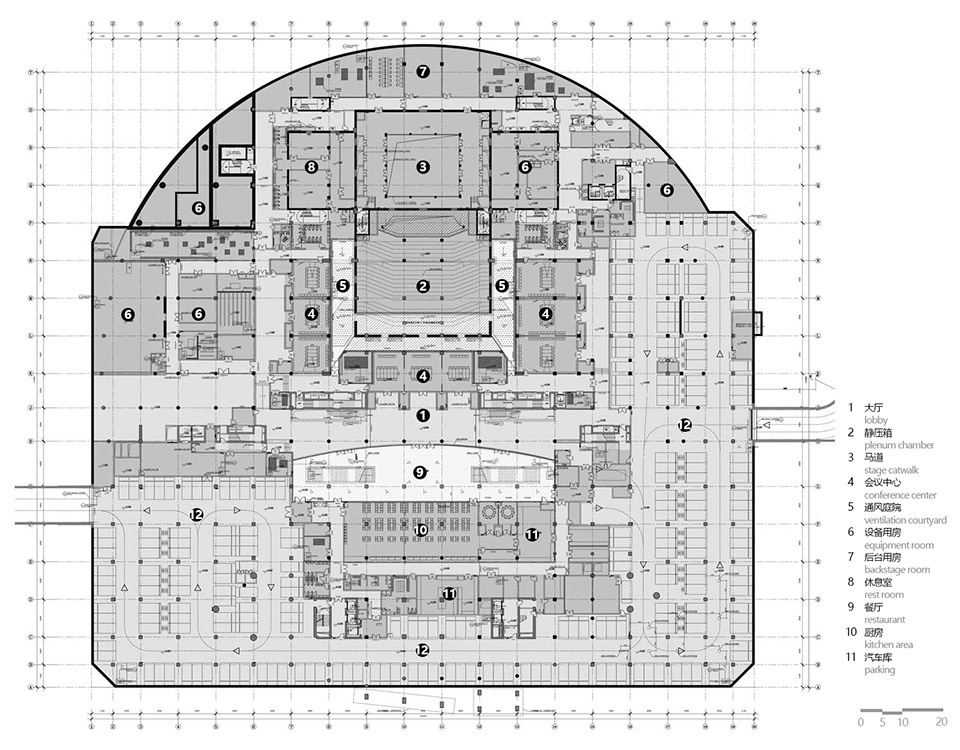
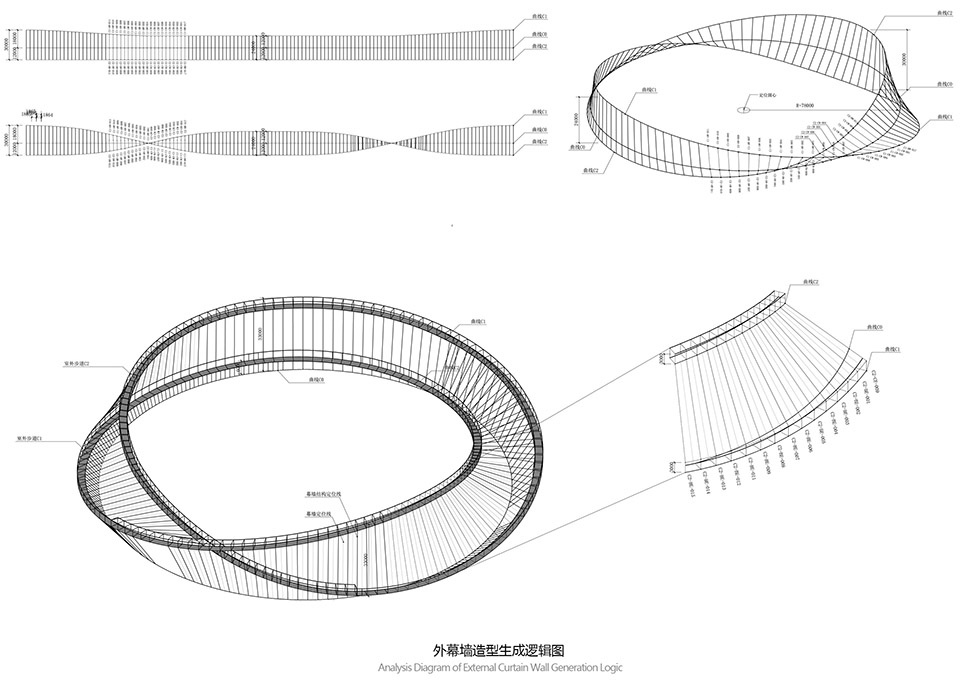
深入研究后发现,两次扭转的莫比乌斯环会呈现“一活一静”的双面形态:南侧面向城市广场,布置青少年活动中心等“活跃功能”,让丰富的形态与热闹的氛围呼应;北侧朝向未来住宅区,安排工人文化宫、老年活动中心等“静态功能”,以沉稳的界面契合静谧的生活节奏。建筑地下整体开挖,中部设会议中心与餐厅厨房,既联通南北两区,又满足各功能的共享需求;莫比乌斯环的两条结构环线自然成面,其交线处形成“露天甬道”——既是进入剧场前的仪式性过渡空间,也是划分功能区块的“隐形边界”。至此,莫比乌斯环不再是单纯的装饰表皮,而是深度参与体量塑造的“结构骨架”。外环之内的建筑实体,则采用正交网格系统,让人员流线与功能布局更清晰,也降低了施工难度;沿外侧设置外廊与公共空间,巧妙消解了“圆形外皮”与“方正内核”的衔接矛盾,既留出通透的“呼吸缝隙”,也增强了建筑的开放性。
In-depth research revealed that a Möbius strip with two twists presents a dual-sided form of “one side dynamic, the other side static”: On the south side (facing the city square), “dynamic functions” such as the Youth Activity Center are arranged, allowing the building’s rich form to echo the lively atmosphere of the square. On the north side (facing the future residential area), “static functions” including the Workers’ Cultural Palace and Senior Activity Center are placed, with a calm facade matching the quiet rhythm of daily life.The entire underground area of the building is excavated, with a conference center, restaurants, and kitchens in the middle—this not only connects the north and south functional zones but also meets the shared needs of various functions. The two structural loops of the Möbius strip naturally form surfaces, and their intersection creates an “open-air corridor”: it serves as a ceremonial transitional space before entering the theater and also acts as an “invisible boundary” dividing different functional blocks. At this point, the Möbius strip is no longer a mere decorative outer layer but a “structural framework” that deeply participates in shaping the building’s volume. The building structure within the outer ring adopts an orthogonal grid system, which not only clarifies the pedestrian circulation and functional layout but also reduces construction complexity. External corridors and public spaces are arranged along the outer side, skillfully resolving the connection conflict between the “circular outer skin” and the “square inner core.” This design not only creates transparent “breathing gaps” but also enhances the building’s openness.
▼外圆内方的建筑形态,Architectural forms that are round on the outside and square on the inside © 百度地图
顺应气候:会“呼吸”的生态剧场
Adapting to the Climate:An Ecological Theater That “Breathes”
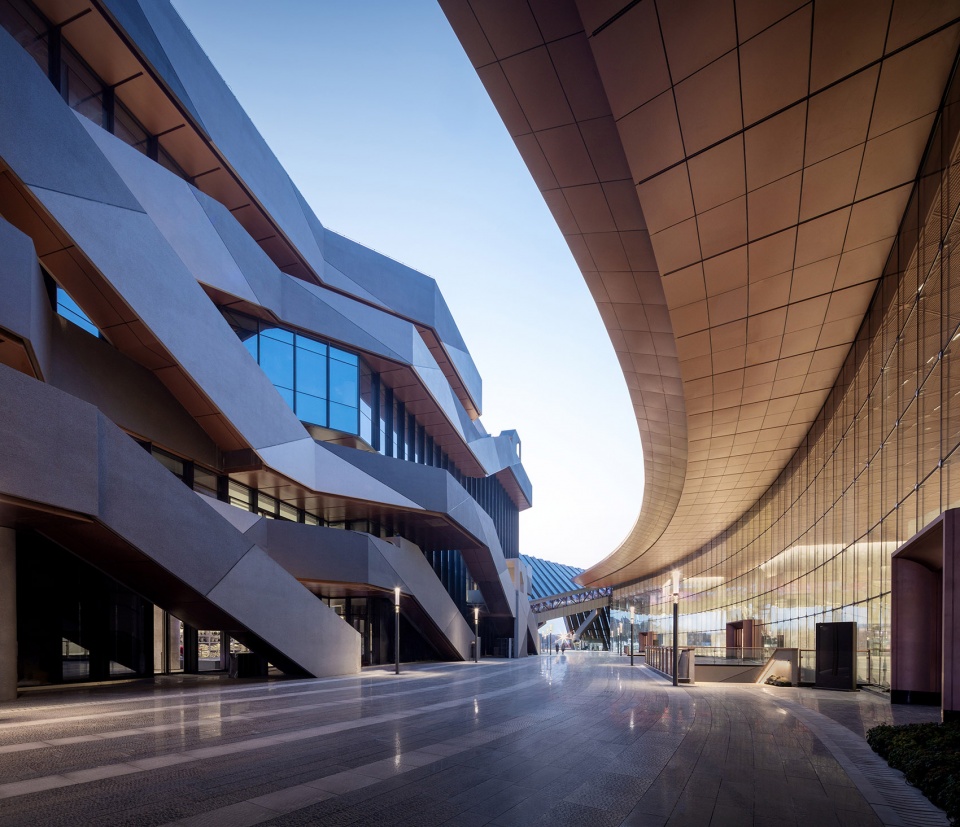
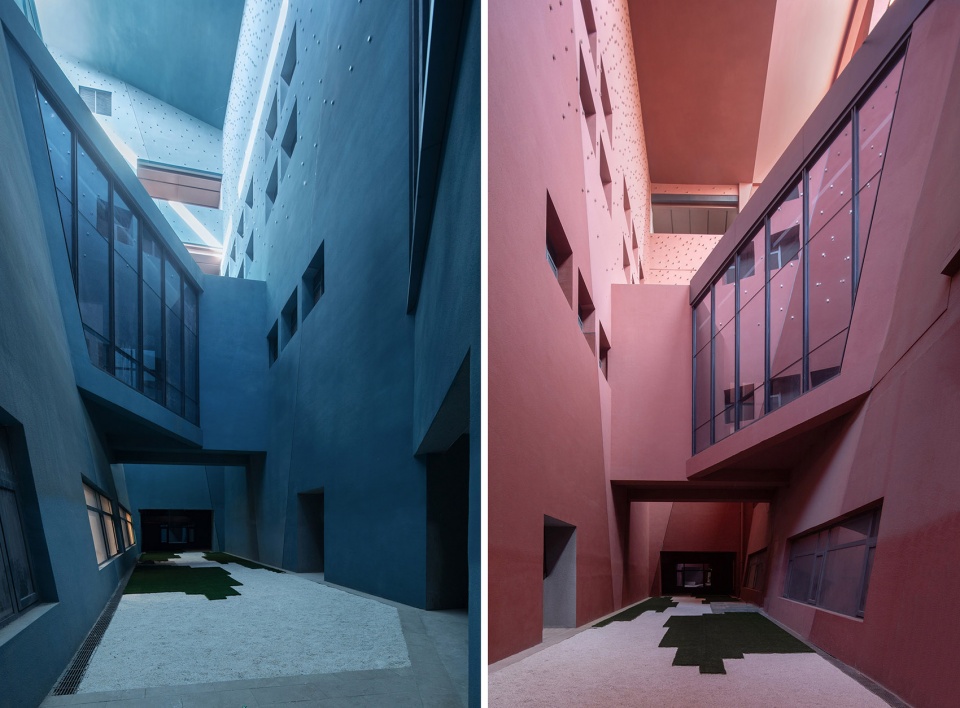
汉中地处暖温带与亚热带的过渡带,夏无酷暑、冬无严寒,且属于非供暖区——这样的气候特征,让“自然通风”成为设计的核心切入点,目标是打造一座“用得起、用得频”的亲民剧场。 设计团队从三个层面构建“自然通风系统”:首先,在总体构型中预留大尺度“露天甬道”,既梳理了南北楼的功能关系,也让观众在进入剧场前,就能感受到穿堂而过的自然风,拉长了“亲近自然”的体验;
▼露天甬道与两侧建筑形成“峡谷”,The open-air passageway forms a “canyon” with the buildings on either side © BIAD
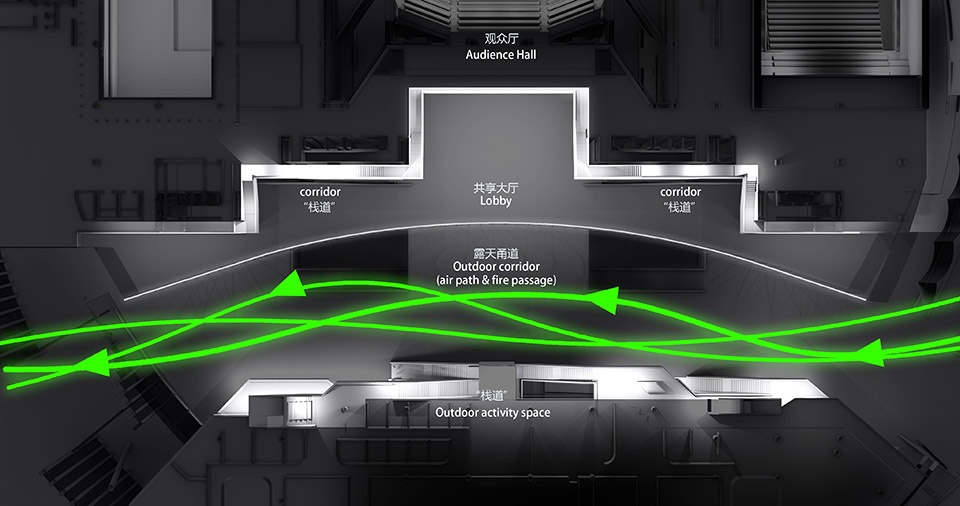
Hanzhong is located in the transition zone between the warm temperate zone and the subtropical zone. It has no sweltering heat in summer and no bitter cold in winter, and it belongs to a non-heating area. Such climatic characteristics make “natural ventilation” the core entry point of the design, with the goal of creating an approachable theater that is “affordable and frequently usable”. The design team has built a “natural ventilation system” from three levels: First, a large-scale “open-air corridor” is reserved in the overall configuration. This not only clarifies the functional relationship between the north and south buildings, but also allows the audience to feel the natural wind passing through the corridor before entering the theater, extending the experience of “getting close to nature”.
▼南北体量之间的露天甬道,An open-air passageway between the north and south volumes © 是然建筑摄影
其次,针对大剧场观众厅这一核心空间,通过物理模型与CFD气流模拟,在其两侧设置“采风中庭”——利用风庭顶部的高差、开口面积与导流路径,结合当地主导风向,为观众厅打造“天然造风系统”,实现过渡季的自然通风;
▼观众厅自然通风分析及CFD气流模拟,Auditorium Natural Ventilation Analysis and CFD Airflow Simulation © BIAD
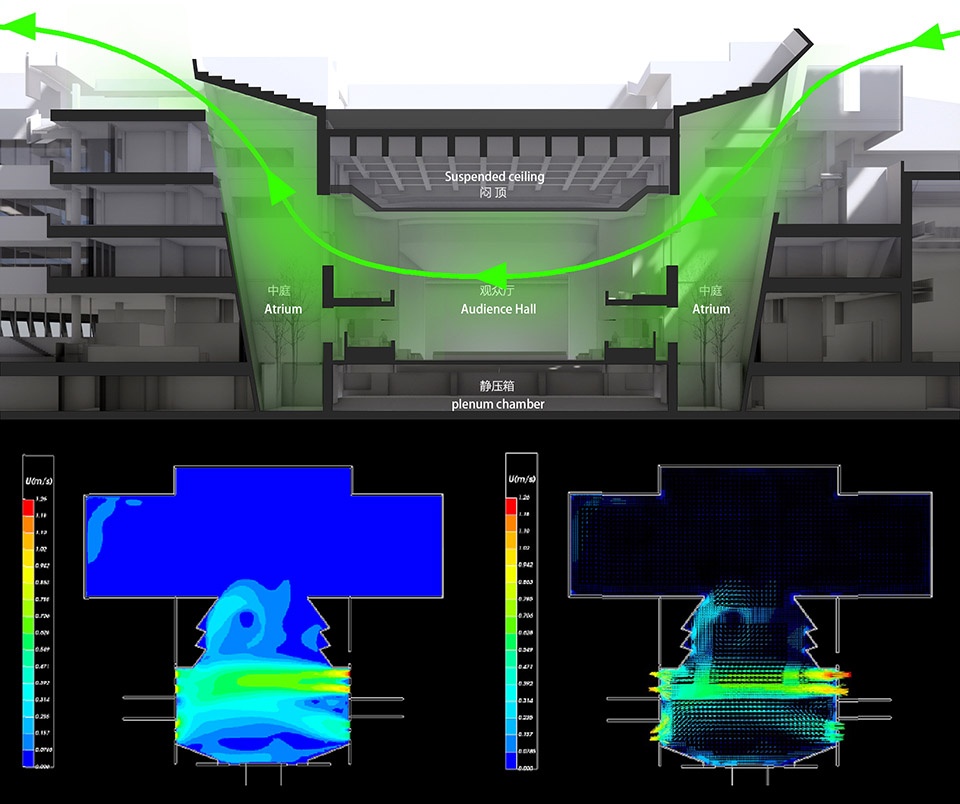
Secondly, for the auditorium of the grand theater – a core space – the design team has installed “wind-collecting atriums” on both sides through the use of physical models and CFD (Computational Fluid Dynamics) airflow simulations. By leveraging the height difference at the top of these atriums, their opening areas, and air diversion paths, while also incorporating the local dominant wind direction, a “natural wind-generation system” is created for the auditorium, enabling natural ventilation during the transition seasons.
▼观众厅外侧的采风中庭及侧墙的“隔声呼吸窗”,The ventilation atrium on the outer side of the auditorium and the “sound-insulating breathing windows” on the side walls © 是然建筑摄影
最后,将通风设计贯穿整个建筑,通过露天庭院、外廊、“风走廊”等设计,让风与阳光能渗透到每个角落,为所有功能空间创造“浅进深、透空气”的条件,最终形成一套专属项目的“微气候”系统。 这些“通风缝隙”还带来了意外收获:建筑体量不再是封闭的“大块头”,而是呈现松散通透的状态,能随时与外部场地联通,大大提升了面向市民的开放性——即便不进入剧场,市民也能在建筑的遮蔽下进行各种活动。
▼连接室外的“风走廊”及CFD气流模拟,The outdoor “wind corridor” and CFD airflow simulation © BIAD
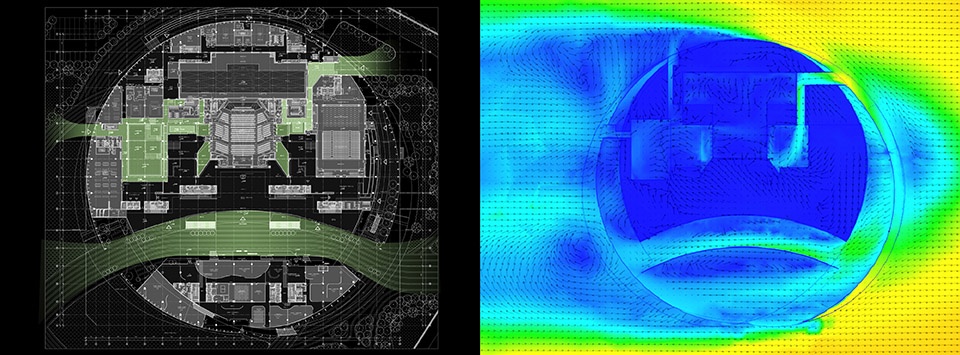
Finally, the ventilation design is integrated throughout the entire building. Through designs such as open-air courtyards, external corridors, and “wind corridors”, wind and sunlight can penetrate every corner, creating conditions of “shallow depth and well-ventilated air” for all functional spaces. Ultimately, this forms a project-specific “microclimate” system. These “ventilation gaps” also bring unexpected benefits: the building volume is no longer a closed “bulk” but presents a loose and transparent state, which can connect with the external site at any time, greatly enhancing its openness to citizens. Even without entering the theater, citizens can carry out various activities under the shelter of the building.
▼设置中庭及外廊保证各功能的自然通风,Designing atriums and exterior corridors to ensure natural ventilation for all functional areas © 是然建筑摄影
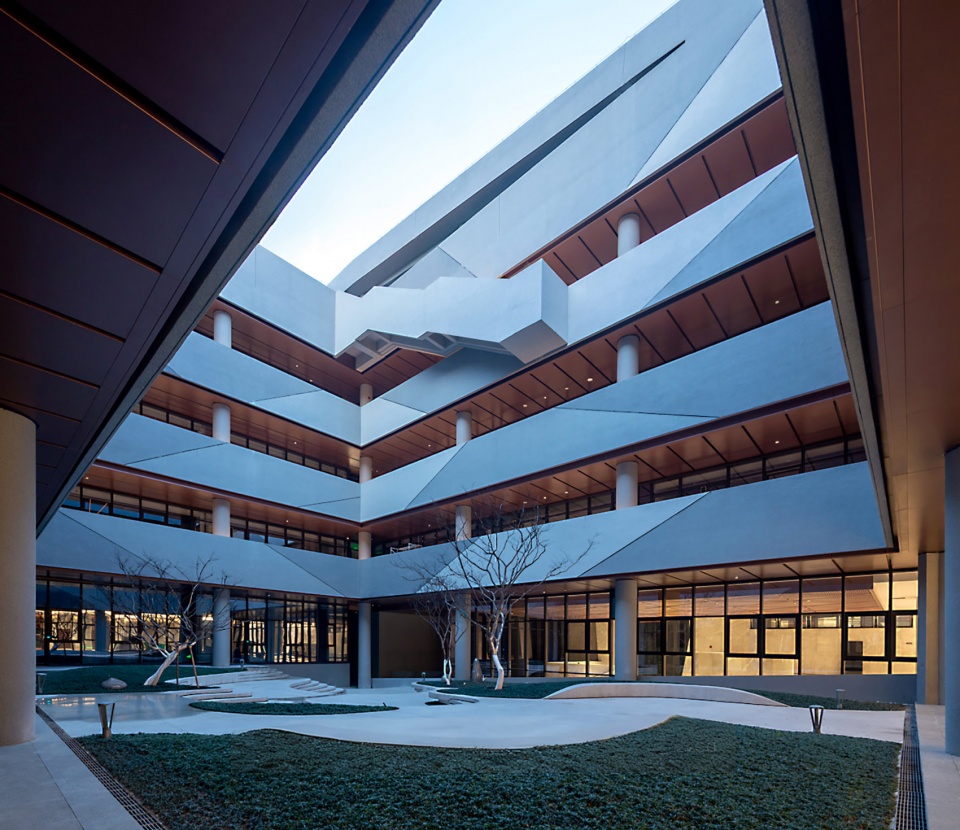
▼大剧院向城市打开的“缝隙”,The Grand Theatre’s “opening” to the city © 是然建筑摄影
“穿越”古今:以古栈道为原型的空间体验
“Crossing Through” Past and Present:A Spatial Experience Inspired by the Ancient Plank Roads
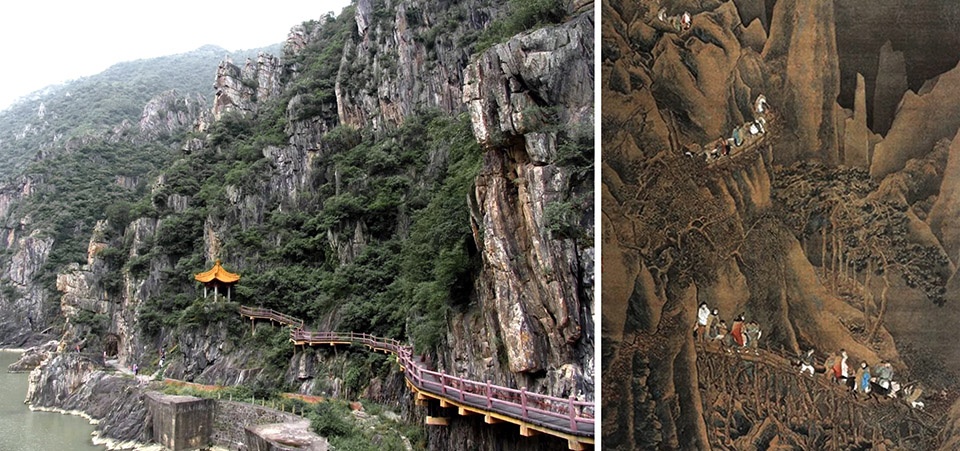
汉中的历史深处,藏着“古栈道”这一标志性遗迹——栈道与山体之间“穿越、出挑、盘旋”的互动关系,以及“窄空间与大山体”形成的强烈对比,总能给人独特的身体感受。设计团队便以“古栈道”为原型,重构了大剧院的公共空间连接方式。 比如,共享大厅内,结合消防功能与开敞体验,打造了“一明一暗”两套楼梯,踏步与扶手的形态模仿栈道的“凌空感”;“露天甬道”南侧建筑的外挂室外回廊,也延续了这种“贴墙而行”的栈道意象。
▼汉中石门栈道及仇英的《剑阁图》,The Stone Gate Plank Road in Hanzhong and Qiu Ying’s Painting of Jiange © 网络
▼大厅疏散楼梯及扶梯与“栈道”的整合,Integration of lobby evacuation staircases and escalators with the “walkway” © 是然建筑摄影
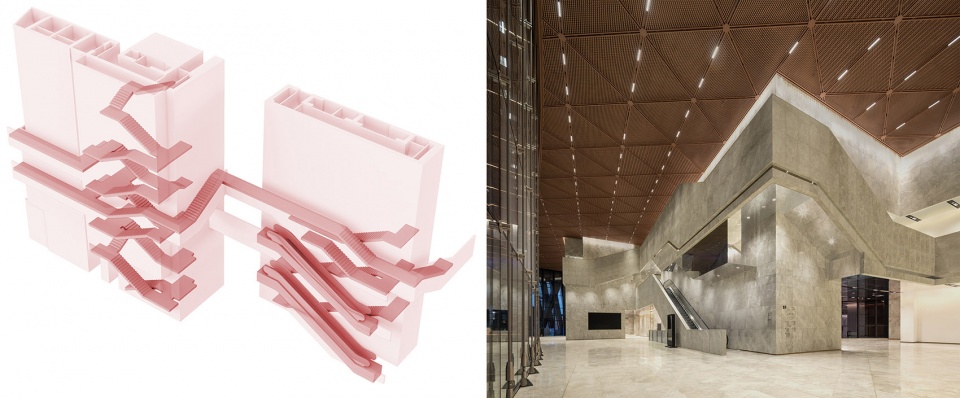
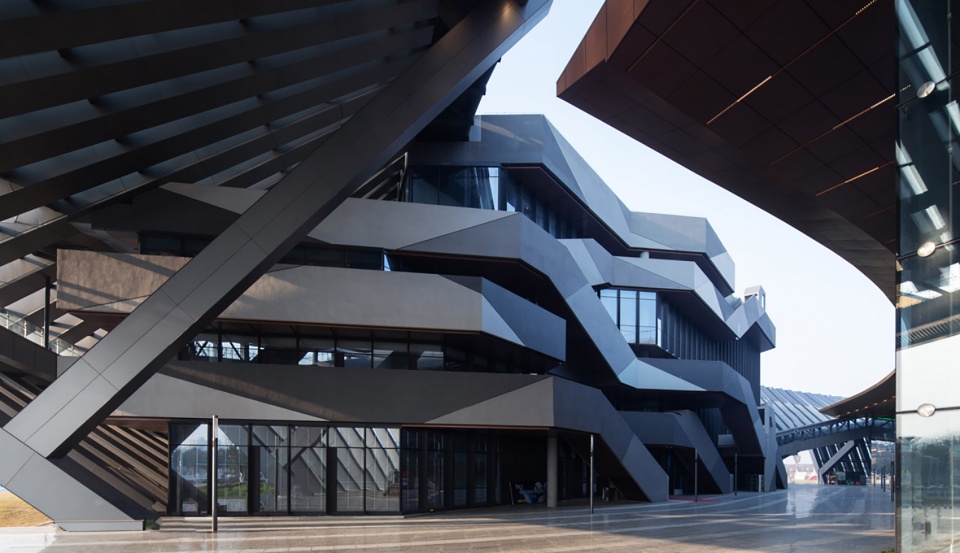
Deep in Hanzhong’s history lies the iconic relic of the “Ancient Plank Roads”. The interactive relationship of “traversing, projecting, and winding” between the plank roads and the mountain massifs, as well as the striking contrast between the “narrow spaces” and the “vast mountain bodies”, always delivers a unique physical experience to people. Drawing inspiration from the “Ancient Plank Roads” as a prototype, the design team reconstructed the connection mode of the grand theater’s public spaces. For instance, in the shared lobby, two sets of staircases—”one bright and one dark”—were created, integrating fire-fighting functions with an open spatial experience. The shape of the steps and handrails mimics the “sense of being suspended in the air” characteristic of the plank roads; the external hanging outdoor corridor attached to the building on the south side of the “open-air corridor” also continues this plank road imagery of “walking along the wall”.
▼南楼立面外挂的“栈道”,The suspended walkway attached to the south building’s facade © 是然建筑摄影
▼共享大厅内横向延展的“栈道”,The horizontally extending “plank walkway” within the shared lobby © 是然建筑摄影
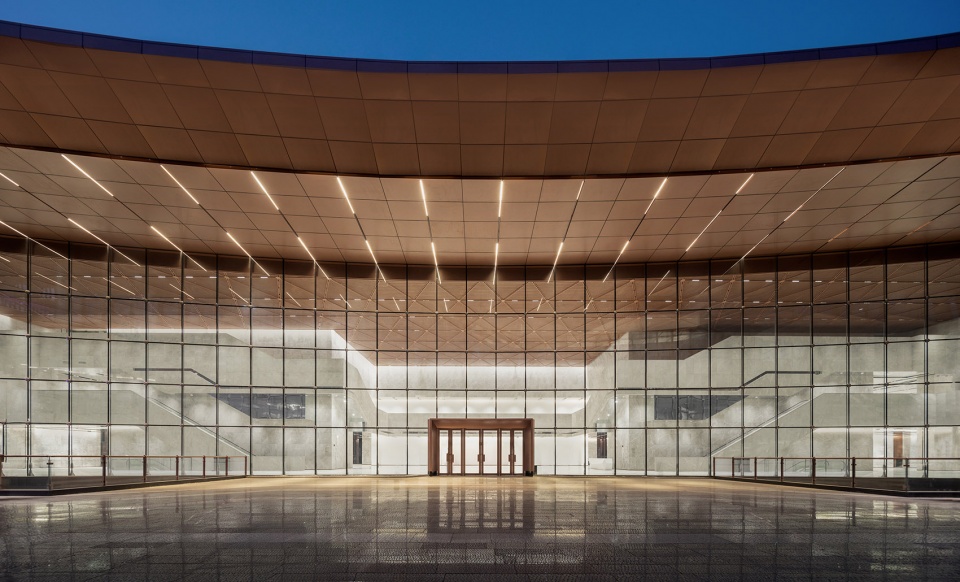
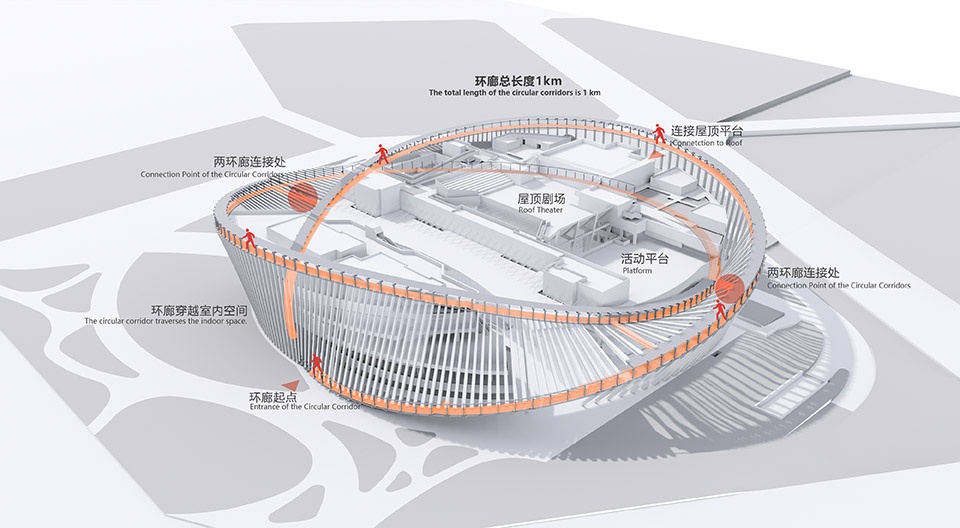
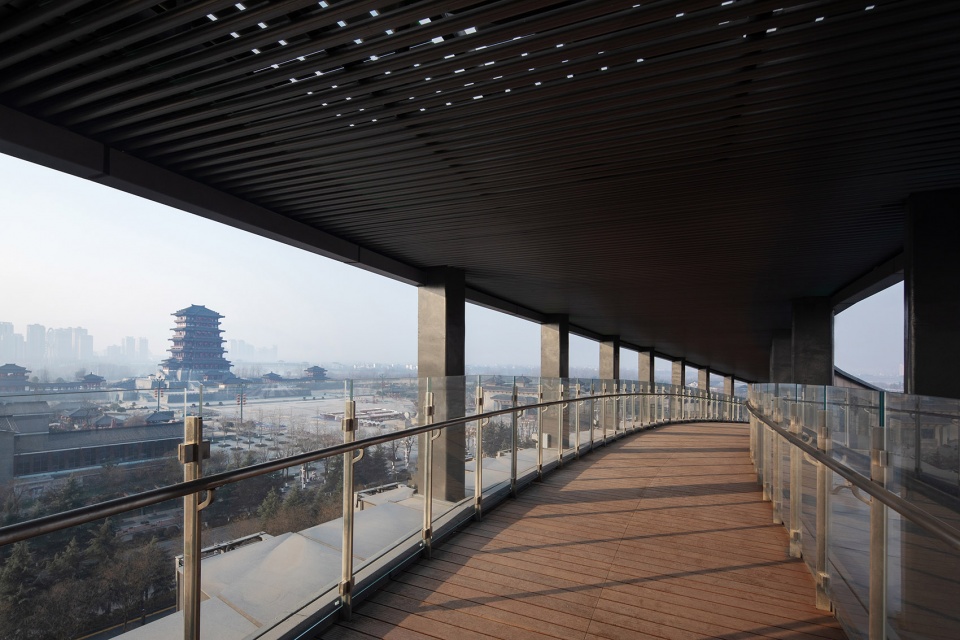
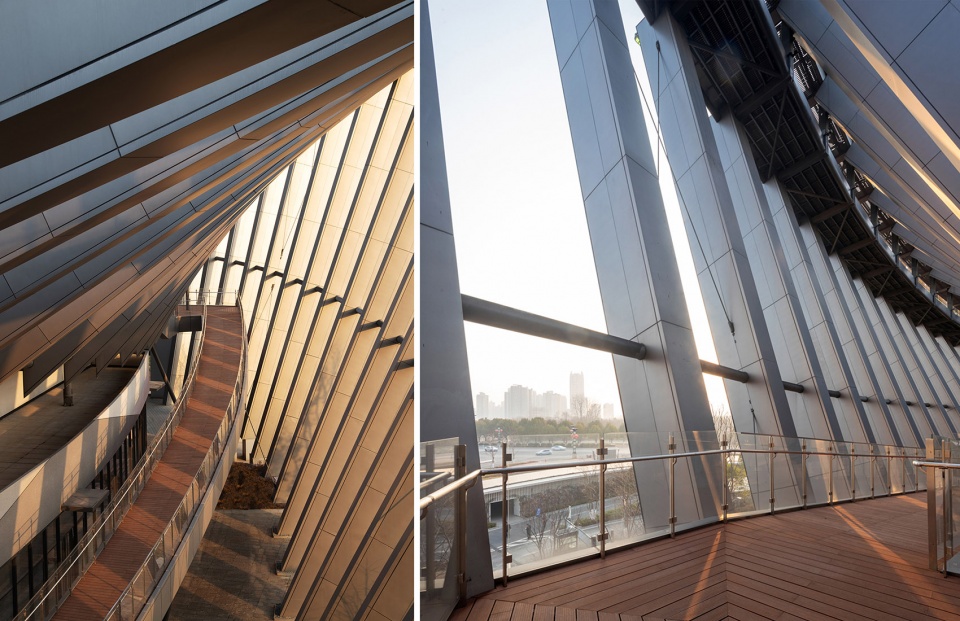
在此基础上,利用莫比乌斯环的结构空腔,打造出两条交织起伏的“空中栈道”——总长度1公里,如同依托建筑而生的“平行空间”。漫步其上,能在不同高度欣赏汉江与城市的景观,两条环线的人流还能在空中交汇、停留;栈道串联起各类室外活动场所,既丰富了“行走与探索”的乐趣,也为商业运营(如临时展览、小型演出)创造了条件。人们感受到的外化形体的“绵延起伏”实则来源于内在行为的“峰回路转”,正所谓“明修栈道,暗渡陈仓。”
▼空中栈道分析,Skywalk Analysis © BIAD
▼空中栈道建成效果,Aerial Walkway Completion Effect © BIAD
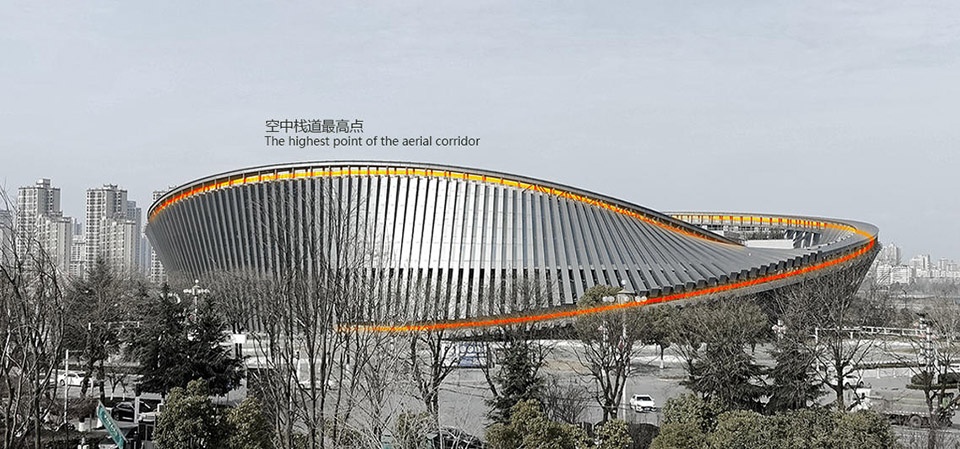
Building on this foundation, the design leverages the structural cavity of a Möbius strip to create two intertwined and undulating “sky plank roads” — with a total length of 1 kilometer — that resemble “parallel spaces” born from the building itself. As visitors stroll along them, they can enjoy views of the Han River and the city from different heights, while the foot traffic on the two loops can also meet and linger in mid-air. These sky plank roads connect various outdoor activity spaces, which not only enriches the pleasure of “walking and exploring” but also creates conditions for commercial operations (such as temporary exhibitions and small-scale performances). The “stretching and undulating” of the building’s external form that people perceive actually stems from the “twists and turns” of internal activities — a concept that echoes the ancient Chinese stratagem: “Openly repair the plank roads, but secretly cross the Chencang path.
▼空中栈道内部空间,Aerial Walkway Interior space © 是然建筑摄影
▼空中栈道起点,Aerial Walkway Starting point © 是然建筑摄影
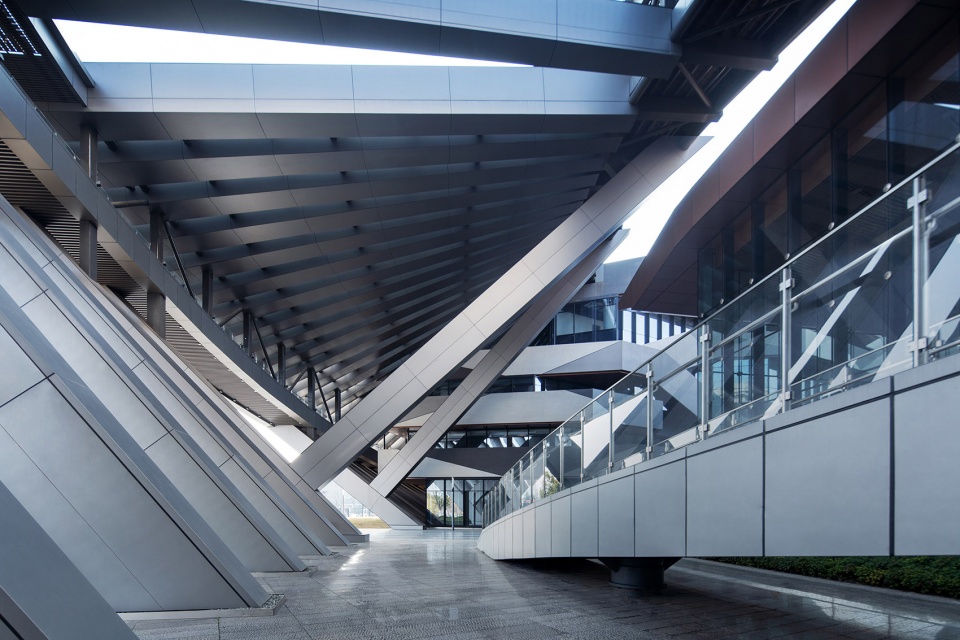
▼空中栈道效果,Aerial Walkway effect © 是然建筑摄影
翻转的汉简:立面造型的“形”与“实”
Inverted “Bamboo Slips”:The “Form” and “Substance” of Facade Design
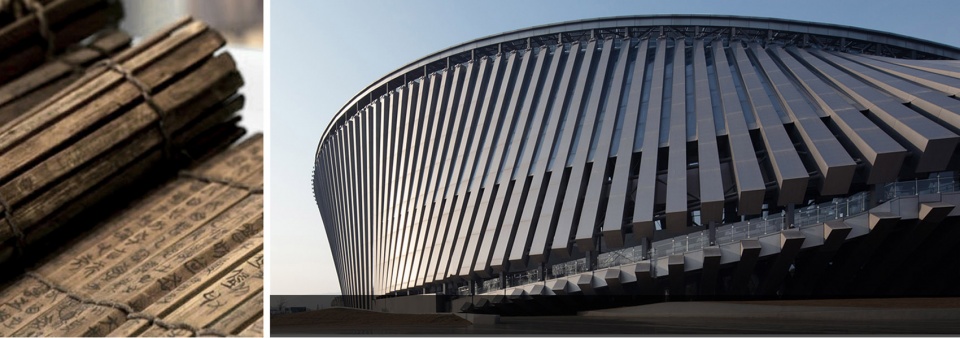
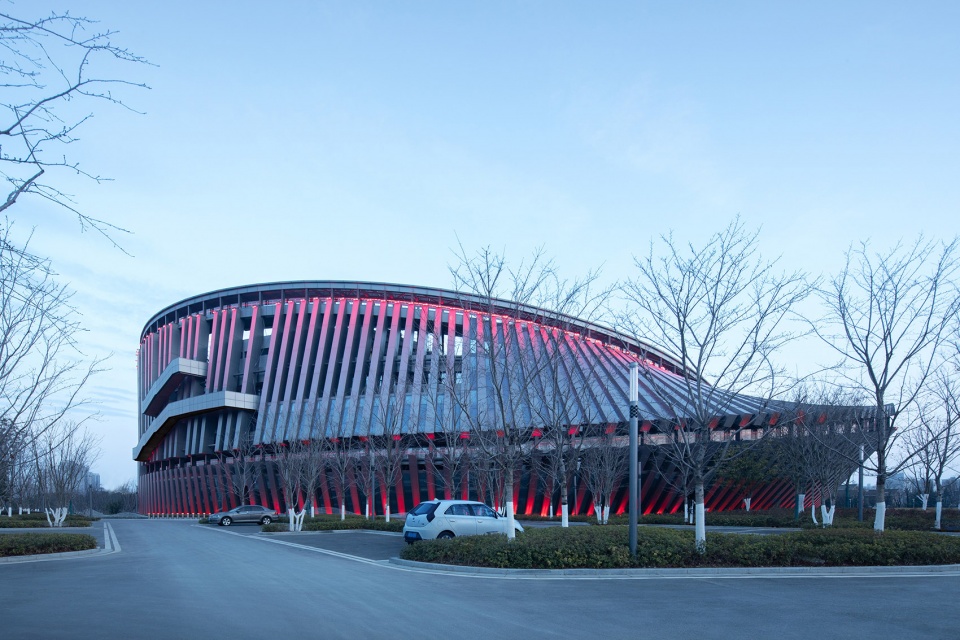
为了让莫比乌斯环的曲面动态更加生动,团队采用“单元格构”的设计,打造出韵律感十足的“条状”竖向表皮——这些连续起伏的线条,宛如徐徐展开的古代“简牍”,既呼应了汉中的历史文脉,也让建筑立面更具细节张力。
在技术实现上,通过Rhino软件对整体造型进行有理化分析,优先保证玻璃单元的尺寸统一,将形态变量消化在实体格构部分——这样既减少了定制化加工的成本,也降低了施工难度。实体格构选用高压热固化木纤维板,这种材料不仅板块分隔灵活、质感多样,且自重轻,能轻松实现外立面的大尺度完整性。
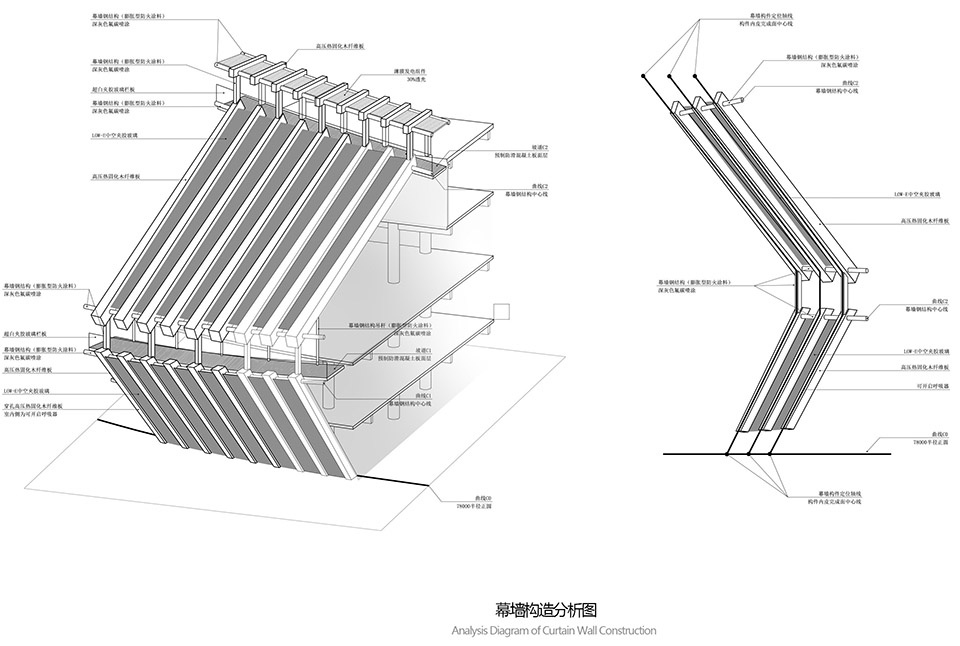
▼立面构造逻辑及单元轴侧图,Facade Construction Logic and Unit Axonometric Diagram © BIAD
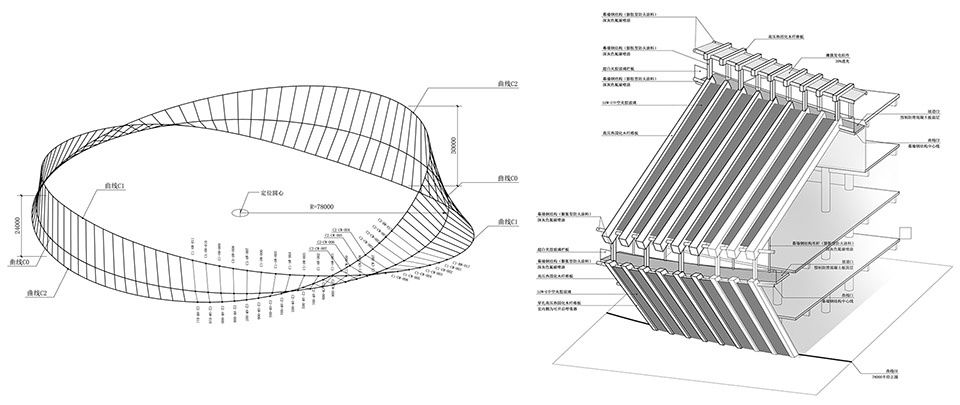
To enhance the vividness of the curved surface dynamics of the Möbius strip, the design team adopted a “cellular grid” design to create a highly rhythmic “strip-shaped” vertical facade. These continuously undulating lines resemble ancient “bamboo slips” unfolding slowly, which not only echo Hanzhong’s historical context but also endow the building facade with greater detailed tension. In terms of technical implementation, the team used Rhino software to conduct rational analysis of the overall shape, prioritizing the uniformity of glass unit dimensions and absorbing shape variables into the solid grid structure. This approach not only reduces the cost of customized processing but also lowers construction difficulty. The solid grid is made of high-pressure thermosetting wood fiberboard. This material not only allows flexible panel division and offers diverse textures but also has low self-weight, enabling easy realization of the large-scale integrity of the external facade.
▼立面细节与“汉简”,Facade Details and “Han Bamboo Slips” © 是然建筑摄影
结构层面,团队沿莫比乌斯环的每条纵切线设置钢架,每榀钢架在楼层处通过销轴(或链杆)与主体结构拉结,再用两道环形空间桁架将所有钢架串联,协调整体变形——这套空间受力体系,既保证了莫比乌斯环形态的完美呈现,也兼顾了结构安全。
▼外圈结构的实现,Implementation of the Outer Ring Structure © BIAD
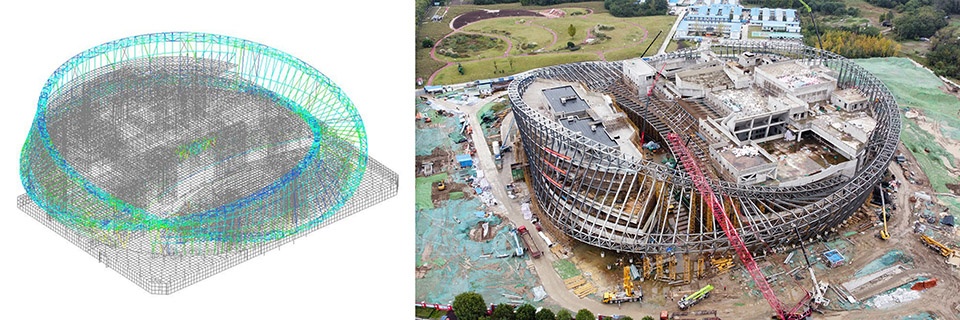
At the structural level, the team installed steel frames along each longitudinal tangent of the Möbius strip. Each steel frame is connected to the main structure at the floor level via pin shafts (or tie rods), and all steel frames are then linked in series by two annular spatial trusses to coordinate overall deformation. This spatial force-bearing system not only ensures the perfect presentation of the Möbius strip shape but also takes structural safety into account.
▼立面格构,Facade Grid © 是然建筑摄影
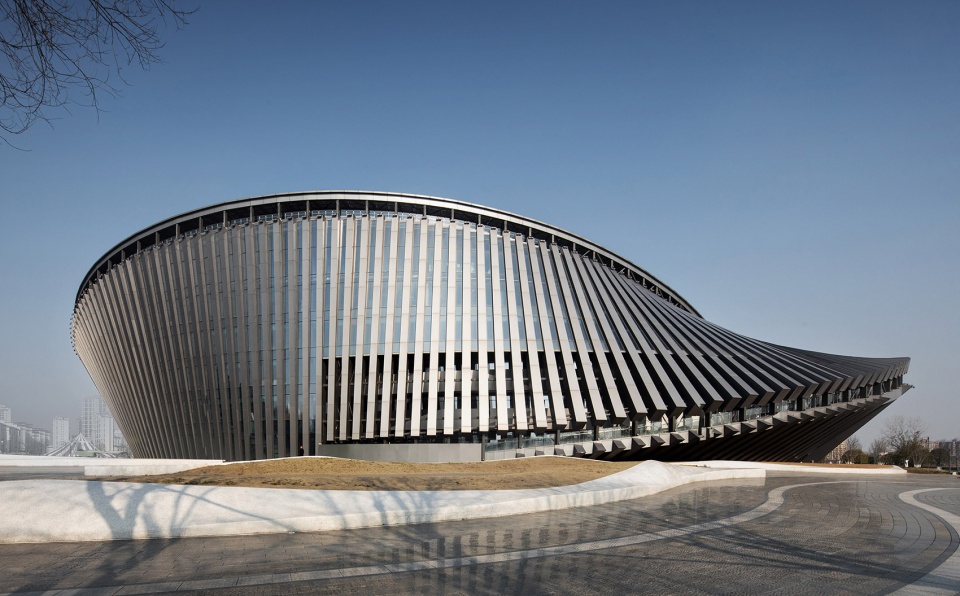
▼立面格构及“空中栈道”,Facade Grid and “Skywalk” © 是然建筑摄影
竹与石的交响:刚柔并济的室内空间
Symphony of Bamboo and Stone:An Indoor Space Blending Rigidity and Softness
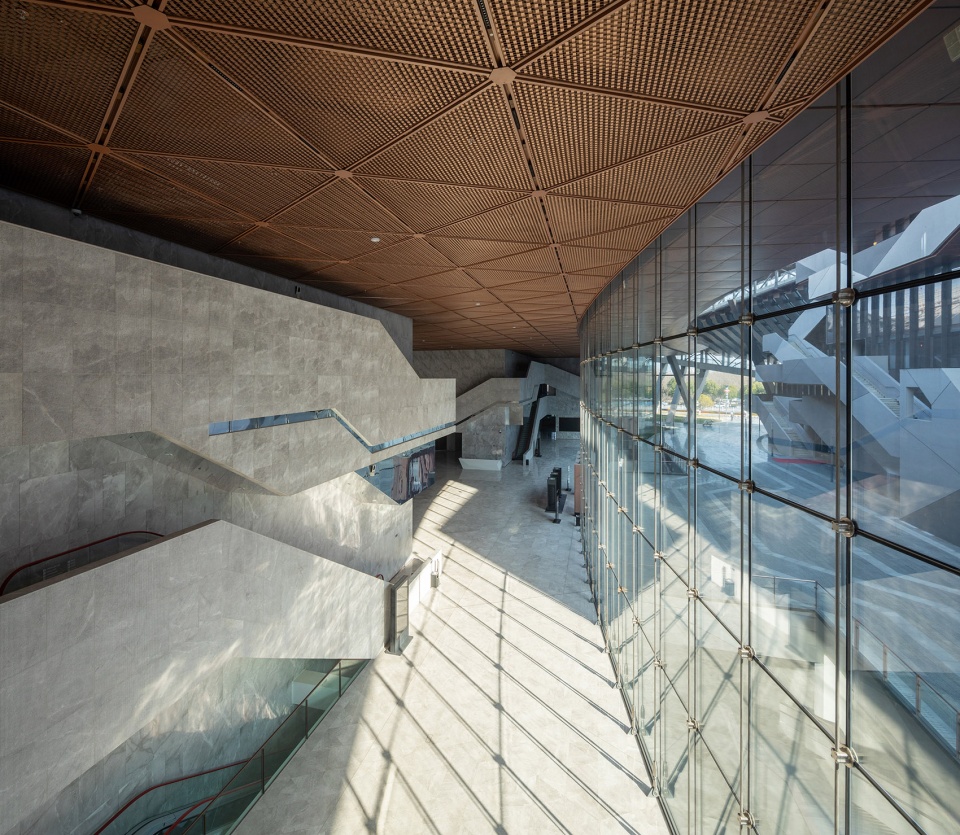
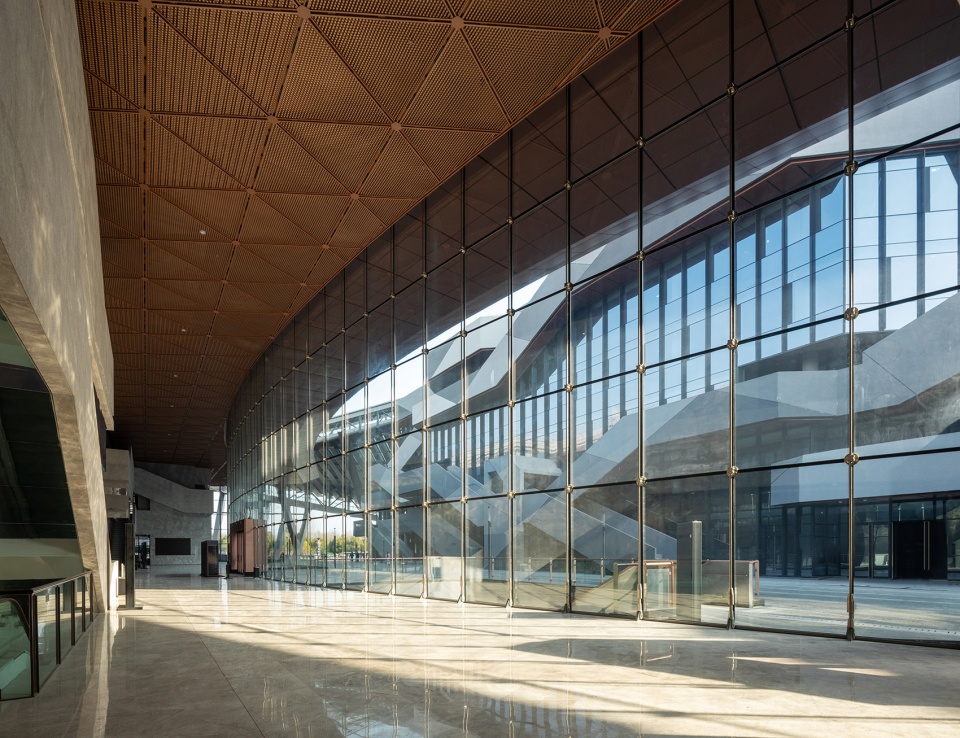
大剧院的室内设计,以“竹与石”为核心材质,营造“外刚内柔”的对比氛围:前厅与公共空间,用石材的沉稳与仿铜色金属吊顶的精致,塑造大气庄重的“公共界面”;而大剧场观众厅与多功能小剧场,则大量采用重竹作为主要装饰材料——竹材的温润质感,既能中和石材的冷硬,也暗合汉中“竹资源丰富”的地域特征。
The interior design of the Grand Theater takes “bamboo and stone” as the core materials to create a contrasting atmosphere of “rigid exterior and soft interior”: In the lobby and public spaces, the calmness of stone and the delicacy of the copper-imitated metal ceiling are used to shape a grand and solemn “public interface”; In the grand theater auditorium and multi-functional small theater, a large amount of heavy bamboo is adopted as the main decorative material. The warm texture of bamboo not only neutralizes the cold hardness of stone but also implicitly echoes Hanzhong’s regional characteristic of “abundant bamboo resources”.
▼共享大厅室内效果,Shared Lobby Interior © 是然建筑摄影
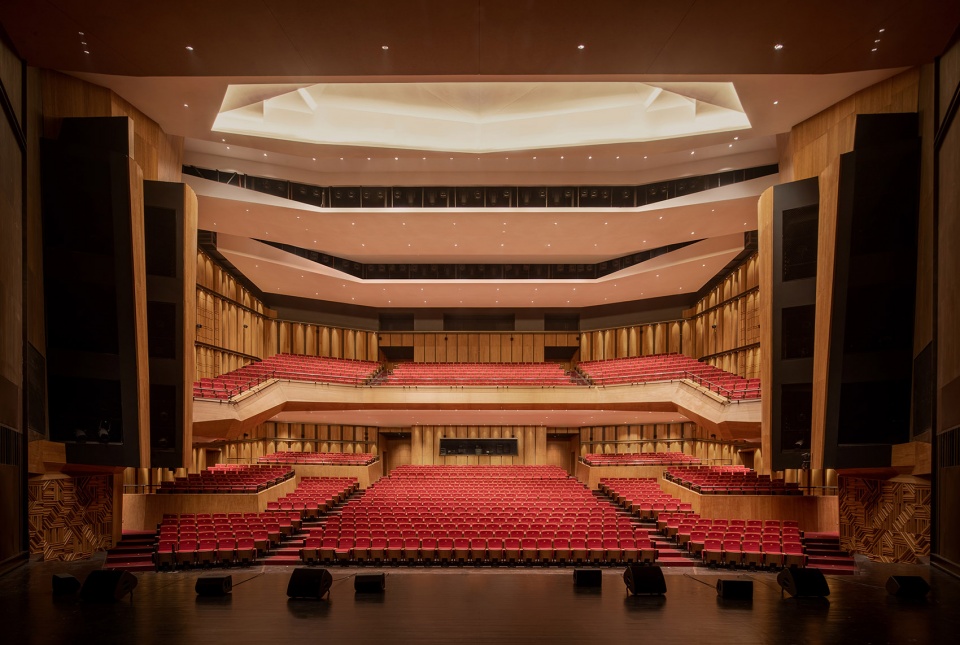
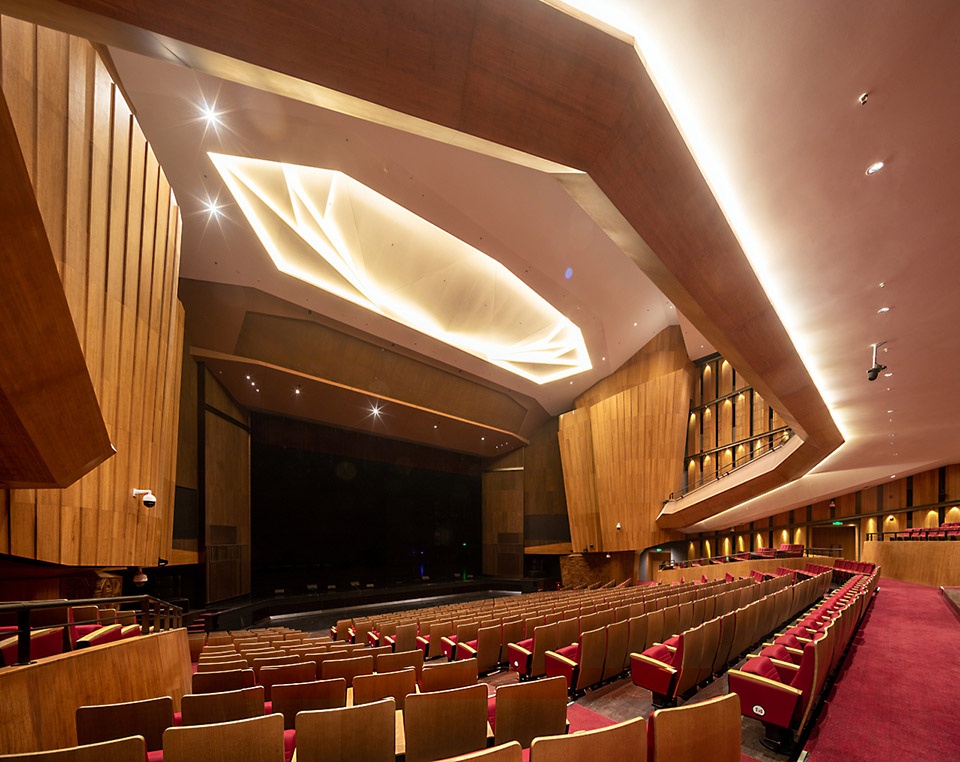
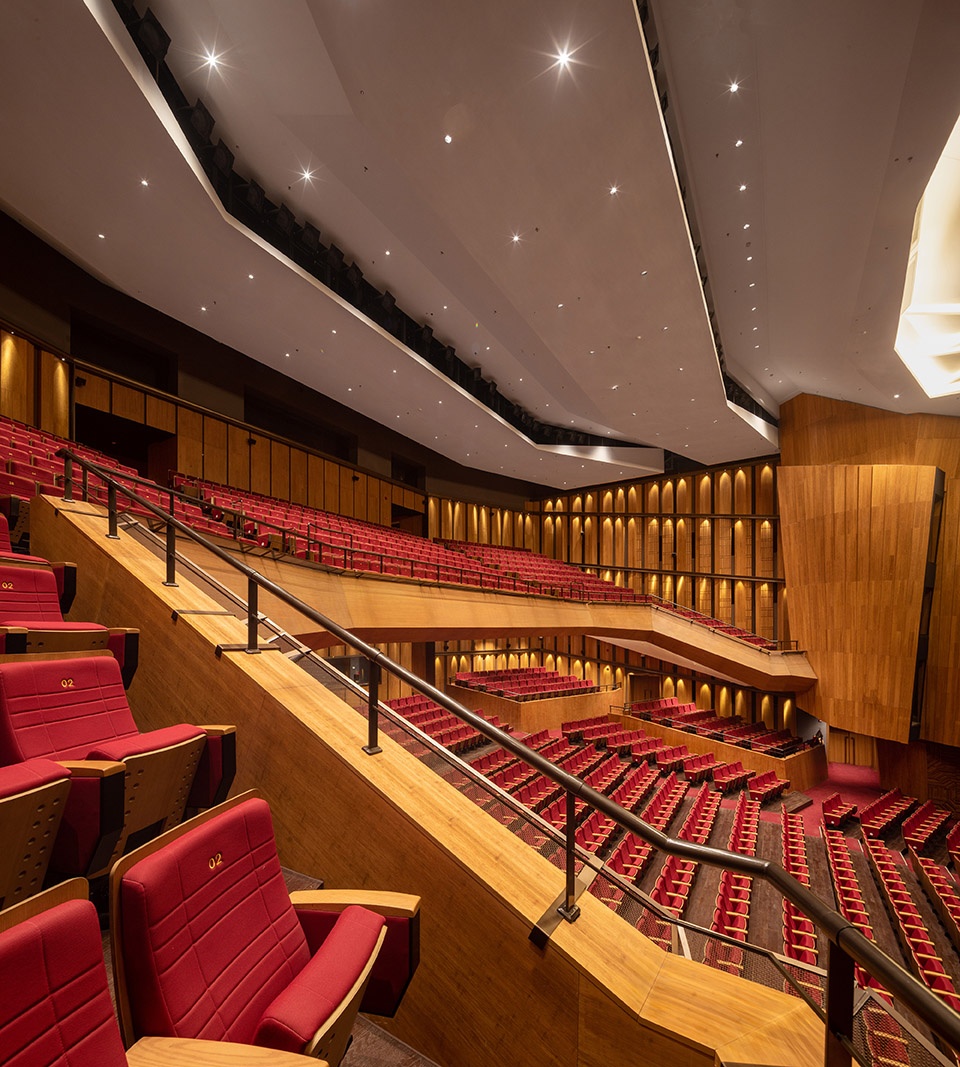
大剧场观众厅的空间以折面形态打造“晶体状”切面结构,既增强了空间的立体感,也利于声学扩散;因池座面宽较大,两侧采用岛式单元布局,既提升了声学效果,也让观众席的视觉体验更丰富。团队结合声学模拟,反复调整观众厅的容积、折板角度与材料做法,确保音效达到最优;顶部则以抽象的“汉莲”造型为装饰,含蓄呼应汉中的文化符号。此外,观众厅立面侧墙的格构与土建墙体之间预留空腔,也为自然通风提供了通道。
The space of the grand theater auditorium is designed with a folded surface to form a “crystal-like” cut structure, which not only enhances the spatial three-dimensional sense but also facilitates acoustic diffusion. Due to the large width of the stalls, an island-type unit layout is adopted on both sides, which not only improves the acoustic effect but also enriches the visual experience of the audience seats. The design team adjusted the volume of the auditorium, the angle of the folded panels, and the material application repeatedly in combination with acoustic simulations to ensure the optimal sound effect. The ceiling is decorated with an abstract “Han Dynasty lotus” pattern, implicitly echoing Hanzhong’s cultural symbols. In addition, a cavity is reserved between the grid structure on the side walls of the auditorium facade and the civil engineering wall, which also provides a channel for natural ventilation.
▼大剧场观众厅,The grand theater auditorium © 是然建筑摄影
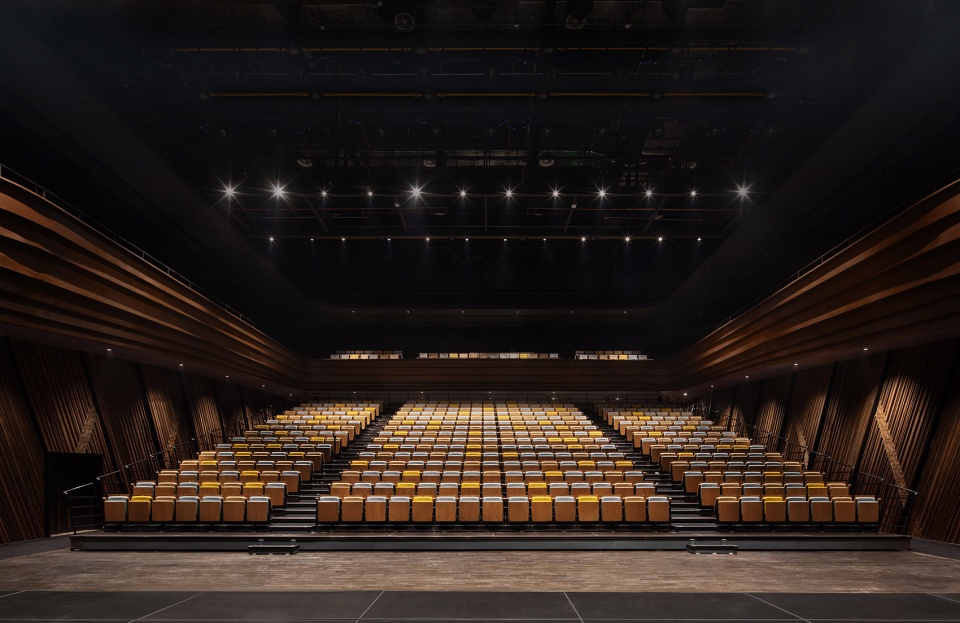
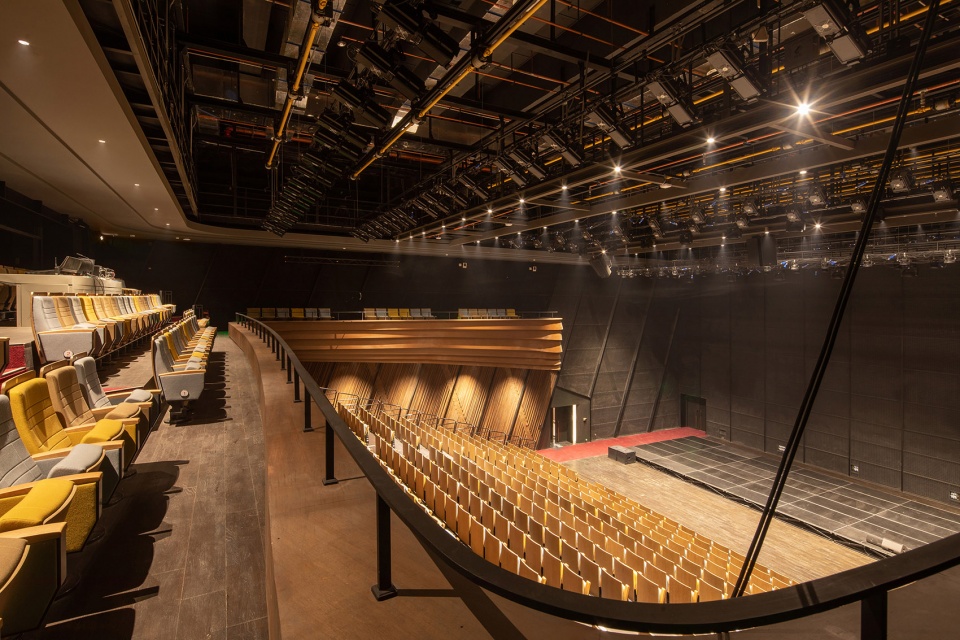
▼多功能小剧场,Multi-Purpose Theater © 是然建筑摄影
▼大剧场观众厅,The grand theater auditorium © 是然建筑摄影
结语
Conclusion
作为汉中市第一座文化综合体,天汉大剧院的落成,不仅为城市增添了一座优雅的“文化地标”——其圆融的形态与汉江的自然景观相映成趣,更用丰富多元的空间,重新定义了“文化建筑”的意义:它不再是仅供“看演出”的封闭场所,而是市民日常活动的“公共客厅”。无论剧场是否有演出,人们都能在这里找到属于自己的乐趣:在露天甬道里散步,在“空中栈道”上赏景,在室外场地参与表演、节庆集会或文化展览,甚至带着孩子在儿童游乐场玩耍;沿着“莫比乌斯环”环廊绕建筑一周,将汉江的波光与城市的烟火气尽收眼底——这种“可游、可玩、可停留”的独特体验,让天汉大剧院真正成为了“生长在汉中土地上,属于每一位市民”的公共文化空间。
As Hanzhong’s first cultural complex, the completion of Tianhan Grand Theater not only adds an elegant “cultural landmark” to the city—its harmonious, rounded form complements the natural landscape of the Han River beautifully—but also redefines the meaning of a “cultural building” through its diverse and versatile spaces: it is no longer a closed venue solely for “watching performances,” but a “public living room” for citizens’ daily activities. Whether there are performances in the theater or not, people can always find their own enjoyment here: strolling in the open-air corridors, enjoying views on the “sky plank roads,” participating in performances, festival gatherings, or cultural exhibitions in the outdoor spaces, or even bringing children to play in the children’s playground; walking around the building along the “Möbius strip” corridor, taking in the shimmering waves of the Han River and the vibrant bustle of the city. This unique experience of being “navigable, playable, and stayable” truly makes Tianhan Grand Theater a public cultural space that “takes root in Hanzhong’s land and belongs to every citizen.”
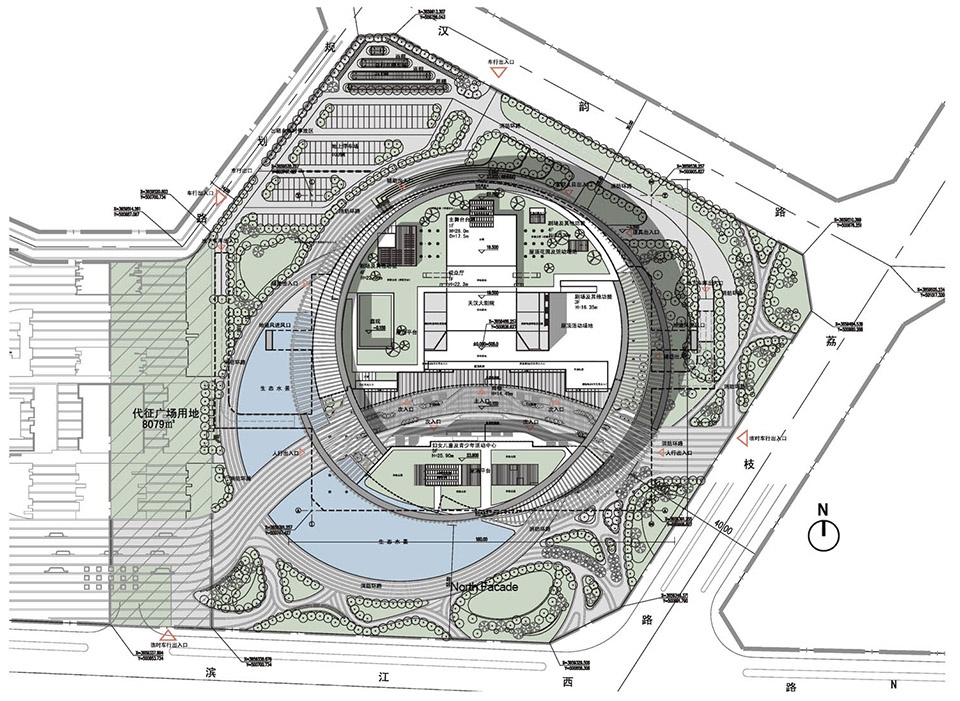
▼总平面图,Master plan © BIAD
▼地下层平面图,Basement floor plan © BIAD
▼首层平面图,Ground floor plan © BIAD
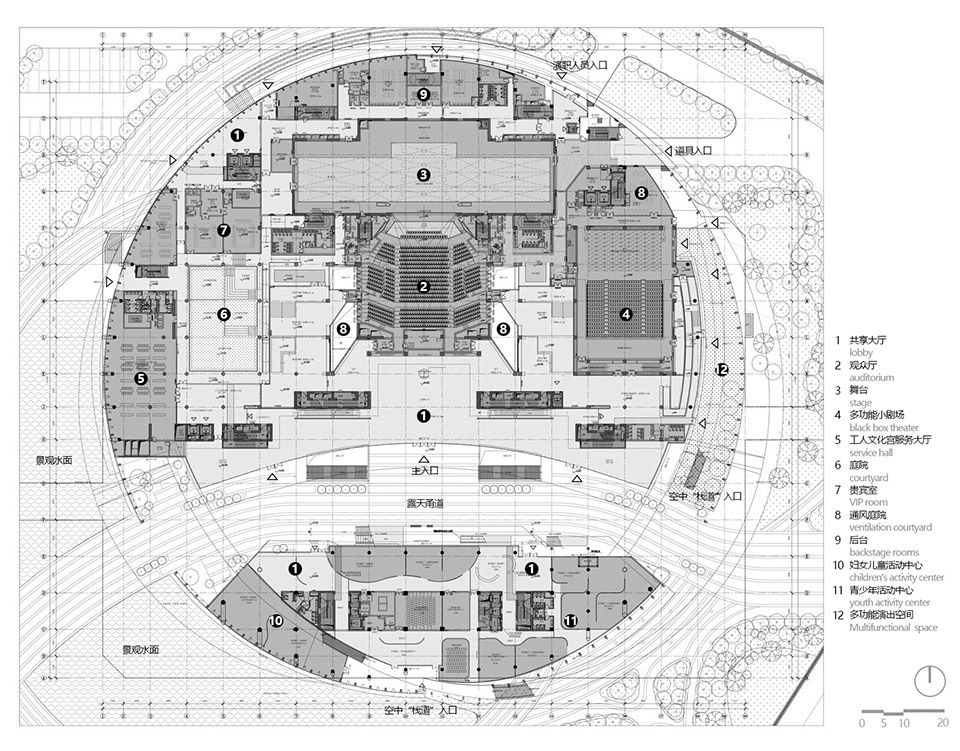
▼二层平面图,First floor plan © BIAD
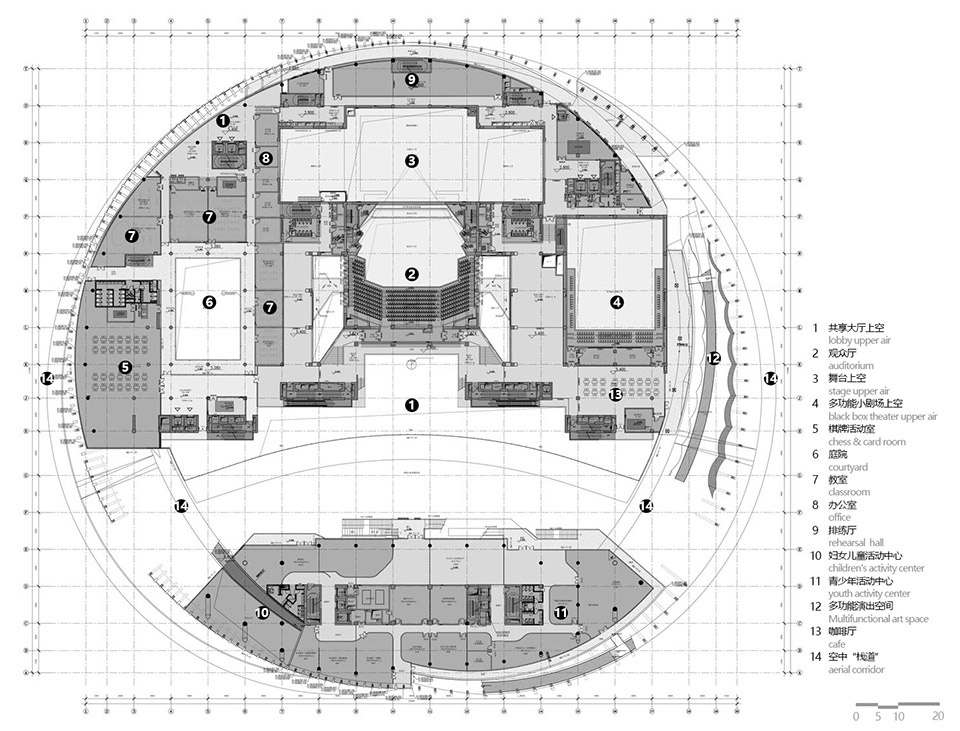
▼三层平面图,Third floor plan © BIAD
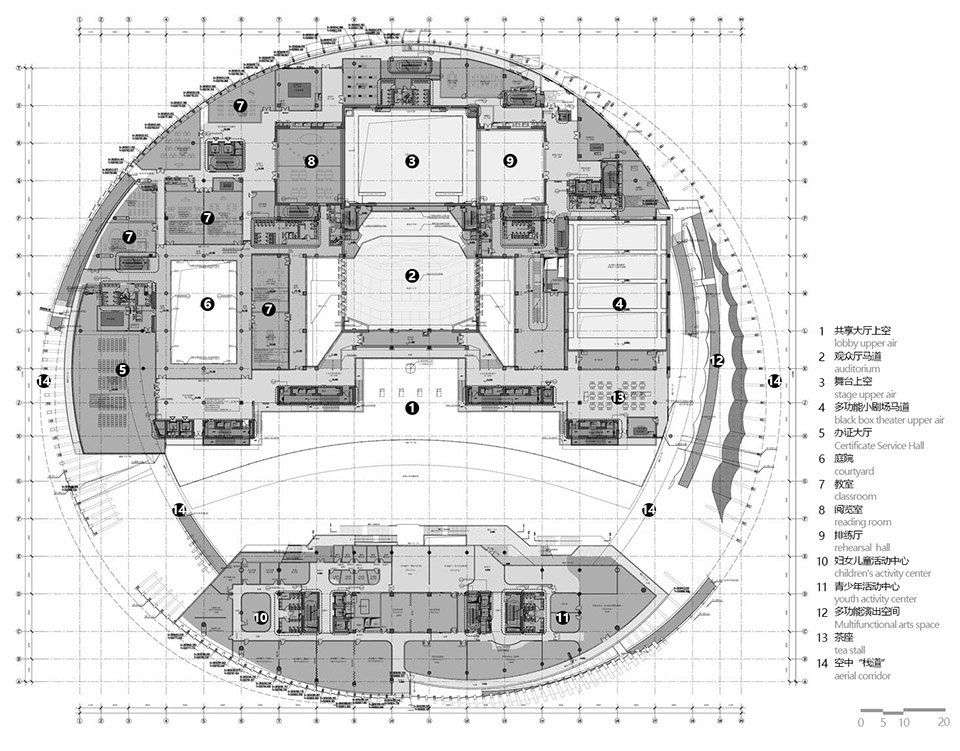
▼四层平面图,fourth floor plan © BIAD
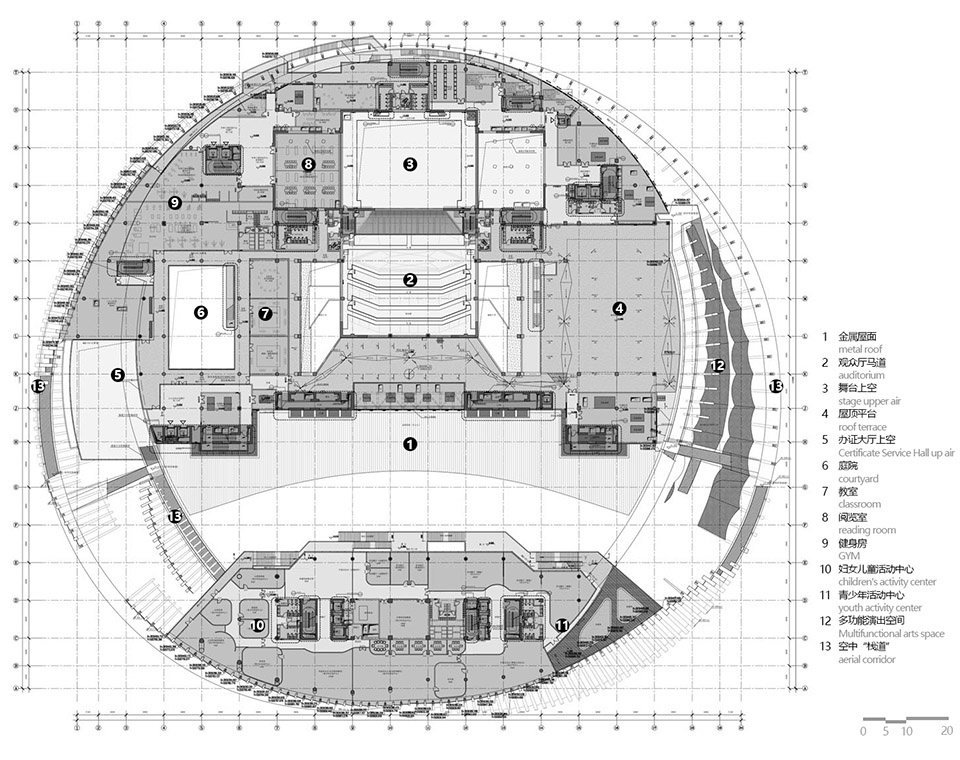
▼立面图,elevation © BIAD
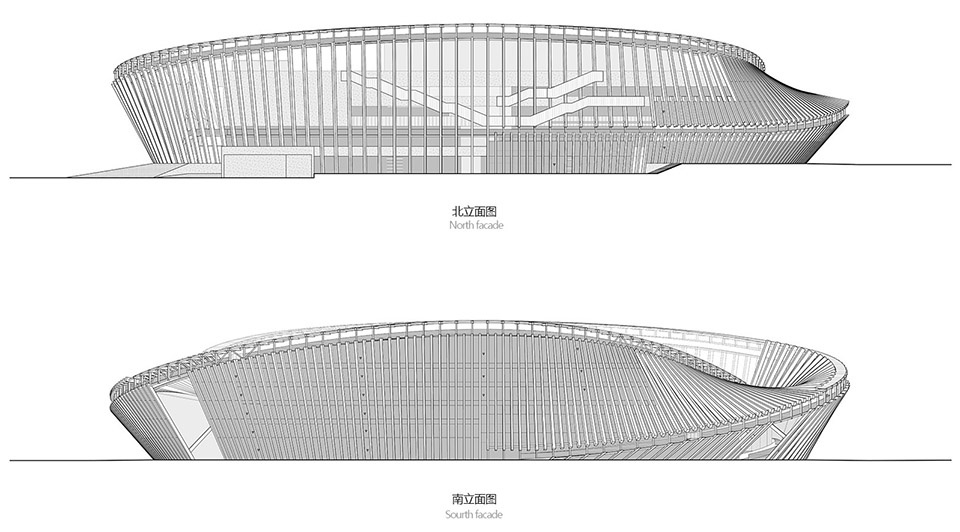
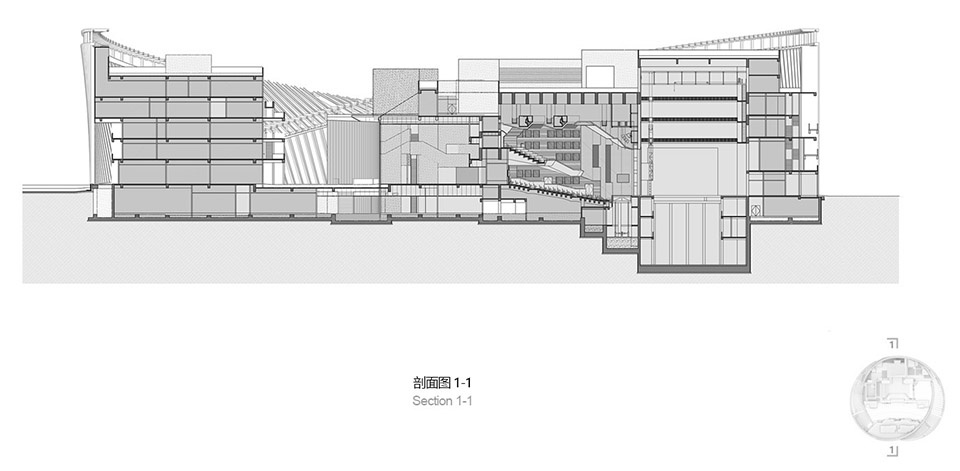
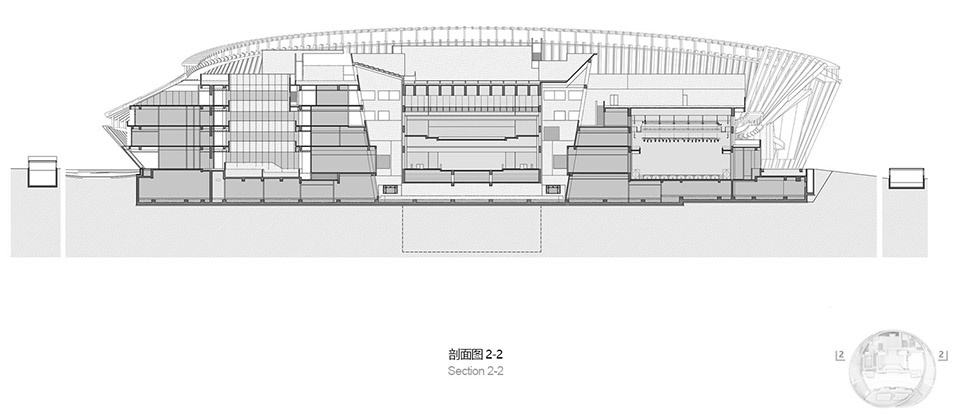
▼剖面图,section © BIAD
▼外幕墙生成逻辑图,Logical Diagram for Exterior Curtain Wall Generation © BIAD
▼幕墙构造逻辑图,Curtain Wall Construction Logic Diagram © BIAD
项目名称:天汉大剧院文化中心
项目类型:观演建筑 文化建筑
设计方:北京市建筑设计研究院股份有限公司
项目设计:2017年
完成年份:2023年
设计团队:米俊仁 张昊 任振华 宫新 聂向东 李大鹏 李玎 郑小双 卢清刚 刘永豪 詹延杰 李隽 毕雅冲 王娟 马珊珊 崔玥 刘世强 冯伟 贾逸群 郭智 李蒙
项目地址:陕西省汉中市汉台区滨江新区
建筑面积:69994㎡
摄影版权:©是然建筑摄影
声学顾问:中广电广播电影电视设计研究院有限公司
风环境模拟:北京建筑大学建筑与城市规划学院
室内设计(部分公共空间):苏州金螳螂建筑装饰股份有限公司
客户:汉中市滨江新区城市建设开发有限公司
材料:高压热固化木纤维板、铝板、真石漆、玻璃


0

0